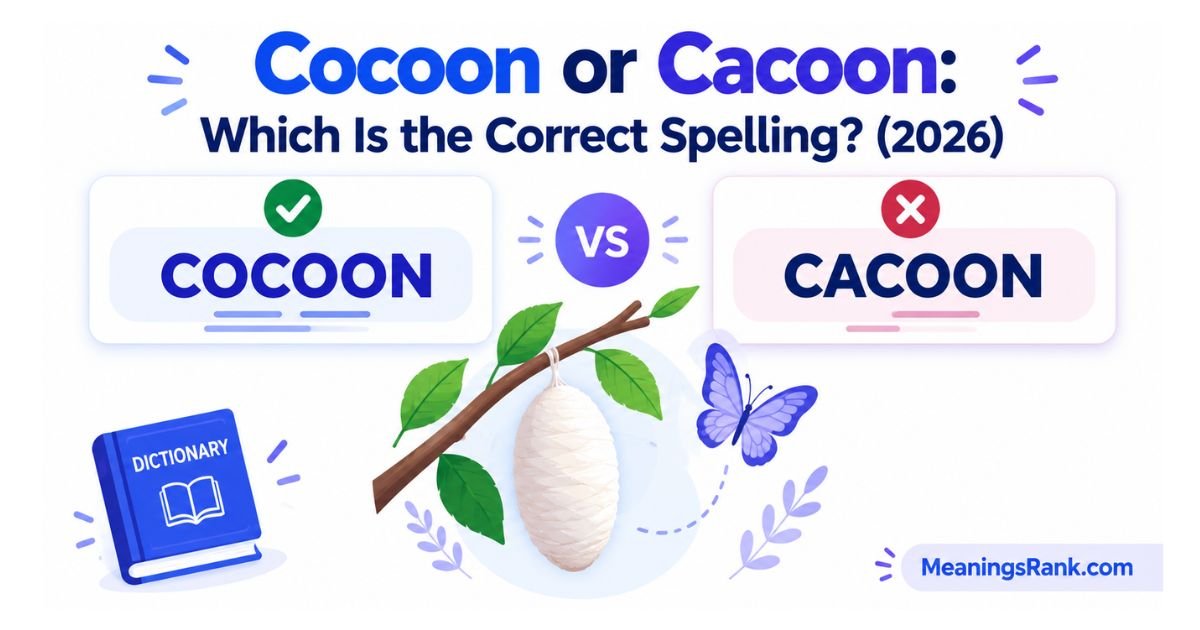

You have typed the word, stared at it, and felt that tiny wobble of doubt. Is it cocoon or cacoon? Plenty of confident writers pause at exactly this spot. This guide settles the question in one line, then walks through the meaning, pronunciation, grammar, and memory tricks that make the right spelling stick for good.
This guide gives you more than the quick fix. You will learn the meaning of cocoon, how to pronounce it, and how it works as both a noun and a verb. You will also see how it differs from chrysalis and how writers use it as a metaphor for rest and personal growth. Practical memory tricks, a short proofreading routine, and a practice quiz follow, so the correct spelling stays with you long after you close this page.
Cocoon vs Cacoon: The Short Answer
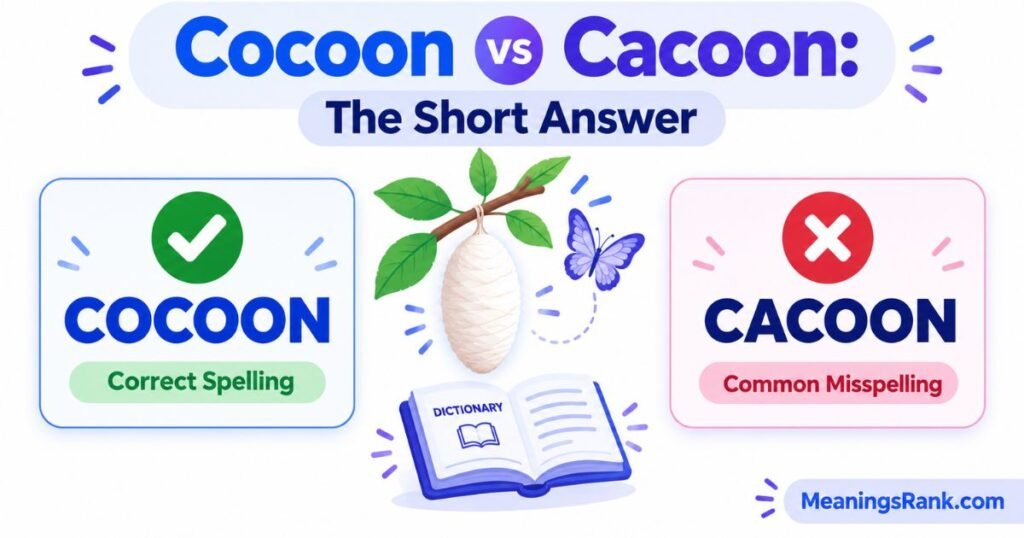
Cocoon is the correct spelling. Cacoon is a misspelling and is not a word in English.
A cocoon is a protective casing, usually made of silk, that some insects spin around themselves while they develop. The word also works as a verb and as a metaphor for any safe, enclosed, comforting space. Every major dictionary, in both American and British English, spells it C-O-C-O-O-N.
Here is a quick reference box you can scan in five seconds:
| Spelling | Status | Verdict |
| Cocoon | Standard English | Correct in every context |
| Cacoon | Not in any dictionary | Incorrect; a common typo |
| Cocoone | Not in any dictionary | Incorrect |
| Cocon | French spelling | Correct in French, not in English |
If you remember only one thing, remember this: there is no letter A anywhere in cocoon. Both vowels in the first syllable and the double vowel in the second syllable are the letter O.
How Do You Spell Cocoon?
You spell cocoon C-O-C-O-O-N. That is six letters, three of which are the letter O. The word has two syllables, and the break falls between the first O and the second C: co-coon.
Notice the pattern. The first syllable, co, is short and sits in an unstressed position. The second syllable, coon, carries the stress and contains the double O that produces the long “oo” sound. Writers who get the spelling wrong almost always stumble on the unstressed first syllable, because unstressed vowels in English tend to blur into a lazy “uh” sound.
The word entered English in the late seventeenth century. It came from the French word cocon, which in turn traces back to a Provençal word meaning a small shell or eggshell. English speakers added the extra O to match the long vowel sound, and the spelling settled into the form we use today. Understanding that history helps explain why the word looks the way it does: it is a borrowed word that wore down into English spelling patterns.
A simple way to lock in the letters is to write them out in pairs: CO + COON. The first chunk is the same two letters that begin “coffee” and “cooperate.” The second chunk rhymes with “moon,” “soon,” and “spoon.” Neither chunk has an A.
What Does Cocoon Mean?
The word cocoon carries three connected meanings, and each one deserves a clear definition.
1. A protective casing made by an insect. This is the original and most literal sense. Many moth caterpillars, along with some other insects, produce a silky covering around themselves before they transform into their adult form. Silkworms are the famous example. The cocoon protects the developing insect from predators, weather, and damage.
2. Something that wraps, covers, or encloses. The word stretches naturally to anything that surrounds and shelters. A newborn wrapped tightly in a blanket, a patient resting in a padded recovery pod, or a fragile object packed in foam can all be described as cocooned.
3. A state of comfort, safety, or isolation. In everyday speech, a cocoon is a sheltered place or condition that shields a person from the outside world. Someone might describe their home as a cocoon on a rainy weekend, or say that a close-knit family kept a child in a cocoon of love.
All three senses share the same core idea: a layer of protection around something that needs safety, warmth, or time to change. Once you hold that image in mind, the word becomes easy to use correctly in speech and in writing.
Read More: Excited vs Exited: Discover the Correct Meaning, Spelling & Usage (2026)
Cocoon Definition in Simple Language
Think of a cocoon as a cozy blanket that an insect makes for itself.
A caterpillar spins soft silk threads around its body. Inside that silk covering, the insect changes slowly, and when it is ready, it comes out as something new, such as a moth. The covering keeps it safe during the change.
People borrowed the idea. When we say someone is “in a cocoon,” we mean they are wrapped up in a safe, quiet, protected space. When we use the verb, we mean to wrap or shield someone or something in that way.
Here is the simplest possible definition, the kind you might give a ten-year-old:
A cocoon is a soft, protective covering that keeps something safe while it changes or rests.
That one sentence works for the insect meaning, the cozy-home meaning, and the personal-growth meaning. The vocabulary changes, but the picture stays the same.
Cocoon in a Sentence
Seeing a word in context is the fastest way to absorb correct spelling and usage. Here are sample sentences grouped by meaning.
| Meaning | Example sentence |
| Insect casing | The silkworm spun a pale yellow cocoon around itself in just three days. |
| Insect casing | We found an empty cocoon attached to the underside of the garden fence. |
| Cozy shelter | After the storm, the family curled up in the cocoon of their warm living room. |
| Protective layer | The antique vase arrived safely, wrapped in a cocoon of bubble wrap. |
| Isolation | He lived in a cocoon of routine and rarely met new people. |
| Verb: to wrap | She cocooned the baby in a soft white blanket. |
| Verb: to shelter | The wealthy heir was cocooned from the realities of ordinary life. |
| Verb: to retreat | Many people cocoon at home during the winter months. |
Look at how the spelling holds steady across every sentence. The noun is cocoon, the past tense is cocooned, and the present participle is cocooning. You never need to alter the vowels, and the letter A never appears.
Here are two more sentences that use the word in slightly more formal writing:
- The research team studied how temperature affects the strength of the silk in each moth cocoon.
- Critics argued that the company’s leadership lived in an echo-chamber cocoon and ignored customer feedback.
Caterpillar Cocoon: A Common Source of Confusion
The phrase “caterpillar cocoon” is one of the most searched combinations involving this word, and it hides a small factual trap.
Many people picture a butterfly caterpillar wrapping itself in a silk cocoon. In reality, most butterfly caterpillars do not make a cocoon at all. They form a hard, smooth shell called a chrysalis. Moth caterpillars, on the other hand, usually do spin a silk cocoon.
So when you write “the caterpillar spun a cocoon,” you are on safe ground only if the caterpillar is a moth species. If you are describing a monarch butterfly, the accurate word is chrysalis.
Spelling matters here too. A writer who is unsure about the insect’s life cycle and also unsure how to spell the word is likely to stack two errors in a single sentence. Getting the spelling right is the easier of the two fixes, and it builds credibility for the facts that follow.
Cocoon vs Chrysalis: What’s the Difference?
Both words describe a protective stage in an insect’s development, but they are not interchangeable.
A cocoon is a covering of silk spun by the insect. It is soft, fibrous, and often fuzzy or woven. Moths and some other insects make cocoons.
A chrysalis is the hardened outer skin of a butterfly pupa. The caterpillar sheds its last larval skin, and the pupa beneath hardens into a smooth shell. Nobody spins anything. The chrysalis is the insect’s own body, in a different form.
Here is a side-by-side comparison:
| Feature | Cocoon | Chrysalis |
| Made by | Silk spun by the caterpillar | The pupa’s own hardened skin |
| Texture | Soft, woven, sometimes fuzzy | Smooth, firm, shell-like |
| Typical insect | Moths, silkworms | Butterflies |
| Plural | Cocoons | Chrysalises or chrysalides |
| Spelling trap | Not “cacoon” | Silent-feeling “ch” with a “k” sound |
| Figurative use | Very common | Rare |
The word chrysalis comes from a Greek term connected to gold, because many chrysalises have a golden or metallic shimmer. It begins with a “ch” that sounds like “k,” which is its own spelling hazard.
Here is a handy way to separate the two: moths make cocoons; butterflies make chrysalises. There are exceptions in the insect world, but this rule works for the vast majority of everyday writing.
In figurative language, “cocoon” wins easily. We say someone is “emerging from a cocoon,” not “emerging from a chrysalis,” unless we want a more poetic or scientific flavor. Both are correct when used with care.
Why Do People Spell Cocoon as Cacoon?
Misspelling is rarely random. It usually has a pattern behind it, and cacoon follows several common ones.
The unstressed vowel problem. In spoken English, the first syllable of cocoon (kuh-KOON) uses a reduced vowel. The sound is close to “uh,” and a speaker who is guessing the spelling may reach for A, which also often represents that soft “uh” sound in words like “about” and “sofa.” The brain fills in the blank with a plausible letter, and the wrong one slips through.
Phonetic spelling. When people type quickly, they write what they hear. “Kuh-koon” can become “cacoon” if the writer chooses A to represent the “uh.”
Visual similarity to other words. Words such as cacao, cactus, and cartoon all start with “ca.” The eye gets used to seeing C followed by A, so the pattern feels natural even when it does not apply.
Autocorrect and speed. On phones, fast thumbs and predictive text can turn a half-typed word into an error that looks plausible enough to survive a quick glance.
Limited exposure in print. Many people say “cocoon” far more often than they write it. Spoken familiarity does not guarantee spelling familiarity.
Understanding the cause helps you fix it. The mistake is not a sign of weak writing ability. It is a normal result of how English connects sound and spelling, and a few deliberate habits will prevent it.
Is Cacoon a Word?
No. Cacoon is not a word in standard English. You will not find it in the Oxford English Dictionary, Merriam-Webster, Cambridge Dictionary, or any other reputable reference. It has no definition, no etymology, and no accepted use.
A few details are worth knowing:
- It is not a regional variant. American, British, Canadian, and Australian English all use cocoon.
- It is not an archaic spelling. Historical texts spell the word with the same O in the first syllable.
- It is not a slang term. No established slang meaning attaches to “cacoon.”
If you see “cacoon” in a text, it is a typo or a spelling error. Proofreaders, editors, and spell-check tools will flag it, and professional readers will notice it.
That said, “cacoon” does occasionally show up as a proper name, a brand name, or a username created on purpose. Those uses are creative choices, not dictionary entries. In ordinary writing, the standard rule applies: the word you want is cocoon.
Is Cacoon Correct?
No, cacoon is not correct. If you are asking whether you can use it in an essay, a blog post, an email, a school assignment, or a published article, the answer is the same each time. Replace it with cocoon.
Here is how that plays out in real situations:
| Situation | Is “cacoon” acceptable? | What to write |
| School essay | No | cocoon |
| Business email | No | cocoon |
| News article | No | cocoon |
| Social media caption | No, but it may pass unnoticed | cocoon |
| Brand or product name | Only as a deliberate creative choice | cocoon (for the common word) |
When in doubt, a quick dictionary check takes less than ten seconds and removes the risk entirely.
Cocoon Pronunciation
The standard pronunciation is kuh-KOON. In the International Phonetic Alphabet, American English speakers typically write it as /kəˈkuːn/.
Break it down:
- First syllable (co): a short, unstressed “kuh” sound, similar to the start of “collect.”
- Second syllable (coon): a long “oo” sound like the word “moon,” with the main stress.
Because the stress falls on the second syllable, the first vowel shrinks into a quiet “uh.” That reduced vowel is the root of the cacoon misspelling. If you say the word out loud slowly, giving each syllable equal weight, you will hear “koh-KOON.” That slower version is a useful spelling aid, because it reminds you that the first vowel is an O.
Rhyming words help with the second syllable. Cocoon rhymes with balloon, lagoon, typhoon, monsoon, and cartoon. Every one of those words uses the double O in the final syllable.
Common pronunciation slips include:
- Stressing the first syllable (KO-koon), which sounds unnatural.
- Shortening the second vowel so it sounds like “cuh-KUN.”
- Adding an extra syllable, as in “co-co-oon.”
Practicing the word aloud a few times, with the stress on the second syllable, builds both clear speech and confident spelling.
Read More: Cancellation vs Cancelation: Discover the Correct Spelling, Meaning & Usage (2026)
Cocoon as a Noun
As a noun, cocoon names a thing: the casing, the shelter, or the protective condition. It is a countable common noun, and its plural is formed by adding an S: cocoons.
Grammatically, it behaves like any other singular noun. It takes articles and determiners, and it can be modified by adjectives.
Subject-verb agreement is straightforward. A singular cocoon takes a singular verb (The cocoon is damaged), and plural cocoons take a plural verb (The cocoons are damaged).
The noun often appears in the pattern “a cocoon of ___,” where the blank holds the material or feeling that wraps around the subject. Examples include a cocoon of silence, a cocoon of warmth, and a cocoon of fog. This structure is especially common in descriptive and literary writing because it turns an abstract quality into a physical image.
Cocoon as a Verb
Cocoon also works as a verb, and this usage is common in modern English. To cocoon someone or something means to wrap, enclose, or shield it, either literally or figuratively.
The verb is regular. You add -ed for the past tense and -ing for the present participle, with no doubled consonant.
| Form | Spelling | Example |
| Base form | cocoon | They cocoon their children from bad news. |
| Third-person singular | cocoons | She cocoons herself in a blanket every night. |
| Past tense | cocooned | The heavy snow cocooned the village. |
| Past participle | cocooned | He felt cocooned by his friends’ support. |
| Present participle / gerund | cocooning | Cocooning at home has become a popular weekend habit. |
The verb can be transitive, meaning it takes a direct object (The foam cocooned the equipment), or it can be used reflexively (She cocooned herself in the quilt). It can also be intransitive in the sense of retreating into a sheltered state (Many people cocoon in winter).
The term “cocooning” gained wide attention in the 1980s, when trend forecaster Faith Popcorn used it to describe people retreating into their homes for comfort and safety. Since then, the word has stuck in business, lifestyle, and media writing.
Watch the spelling with the verb forms. People who write “cacoon” often carry the mistake into “cacooned” and “cacooning,” so the error multiplies. Fixing the base word fixes all the forms at once.
The Figurative Meaning of Cocoon
Figurative language uses a word in a non-literal way to create an image or express an idea. Cocoon is a strong example, because the physical picture of a silk wrapping carries over so naturally to human experience.
The figurative meaning usually falls into one of two moods:
A positive mood: comfort and protection. Here the cocoon is a refuge. Examples include a cocoon of warmth, a cocoon of family love, and a cocoon of quiet. The word suggests safety, softness, and rest.
A negative mood: isolation and avoidance. Here the cocoon is a barrier. Examples include living in a cocoon of privilege, a cocoon of denial, and an ideological cocoon. The word suggests someone who is shielded from reality, challenge, or other viewpoints.
The same word can carry praise or criticism, and the surrounding words decide which one you mean. Compare these two sentences:
- The cabin was a cocoon of warmth against the freezing night. (positive)
- The senator lived in a cocoon and never heard dissenting voices. (negative)
Because the word is flexible, it appears in many fields. Psychologists discuss emotional cocoons. Journalists write about political cocoons. Interior designers describe cocoon-like bedrooms. Marketers promote “cocoon” blankets and chairs.
Whatever the field, the spelling does not change. Figurative use is simply a matter of choosing the right context, and the grammar remains the same as in the literal sense.
Cocoon as a Metaphor for Personal Growth
One of the most loved uses of the word is as a metaphor for personal change. The logic is simple and appealing: an insect goes into a protective casing, stays there while it transforms, and emerges as something different.
Writers apply this image to many real-life experiences:
- A quiet season of rest. After burnout, a person may withdraw to recover, and the retreat becomes a cocoon in which strength is rebuilt.
- A period of study or training. A student who spends a year focused entirely on a craft may later “emerge from the cocoon” with new skills.
- Recovery after loss. Grief often calls for a protected space where healing happens slowly.
- A career transition. Someone changing professions may spend months out of the spotlight, preparing for the next chapter.
The metaphor works because it respects the need for patience. Growth does not always look impressive from the outside. Inside a cocoon, little seems to happen, yet significant change is underway.
A well-built sentence might read: She spent the winter in a cocoon of study, and by spring she emerged ready to teach. Notice the clear subject, the descriptive prepositional phrase, and the matching verb emerged. The spelling, as always, remains C-O-C-O-O-N.
When Should You Use the Word Cocoon?
Use cocoon whenever you need to describe a protective covering, a sheltered space, or the act of wrapping something safely. The word fits a wide range of settings, but the best choice depends on your purpose and audience.
Use it in science and nature writing when you are describing moths, silkworms, or other insects that spin silk casings. Be precise and avoid the term for butterfly pupae.
Use it in descriptive and creative writing when you want a warm, sensory image. Cocoon appeals to touch and comfort, so it pairs well with words like soft, quiet, and warm.
Use it in lifestyle and home content when discussing cozy rooms, comfortable fabrics, or the habit of staying in. The verb cocoon and the noun cocooning fit these topics naturally.
Use it in opinion and analysis writing when critiquing someone’s isolation from reality. A phrase like “a cocoon of privilege” is vivid, but it is also judgmental, so use it with care.
Avoid it when a plainer word would serve better. In technical or legal documents, enclosure, casing, or covering may be clearer than a metaphor. In a message about a butterfly, use chrysalis.
A good test is to ask yourself two questions. First, does the image of a protective wrapping match what I mean? Second, will my reader understand the intended mood, whether comforting or critical? If both answers are yes, cocoon is a strong choice.
Common Words Related to Cocoon
Building a small vocabulary cluster around cocoon helps you write with more range and gives you alternatives when the word starts to repeat.
| Word | Part of speech | Meaning | Relationship to cocoon |
| Chrysalis | Noun | The hardened pupa stage of a butterfly | Similar concept, different insect |
| Pupa | Noun | The inactive stage between larva and adult | The creature inside a cocoon |
| Larva | Noun | The early, worm-like stage of an insect | What spins the cocoon |
| Metamorphosis | Noun | A complete change of form | What happens inside |
| Silk | Noun | The fiber spun for the cocoon | The material |
| Cocooning | Noun / gerund | Retreating into a comfortable home life | Lifestyle sense |
| Cocooned | Adjective / past participle | Wrapped up or sheltered | Descriptive form |
| Shelter | Noun / verb | Protection from harm | Close synonym |
| Sanctuary | Noun | A safe, protected place | Figurative synonym |
| Enclose | Verb | To surround on all sides | Verb synonym |
Notice that none of these related words contains the spelling pattern “cac.” That is a useful reminder: the whole word family keeps its Os steady.
Cocoon Spelling Mistakes to Avoid
Misspellings tend to cluster around a few predictable errors. Here are the ones you are most likely to meet, along with the fix for each.
| Incorrect | Correct | What went wrong |
| cacoon | cocoon | The unstressed first vowel was replaced with A |
| cocoone | cocoon | An extra silent E was added |
| cocoun | cocoon | The double O was replaced with “ou” |
| cokoon | cocoon | The hard C sound was spelled with K |
| coccon | cocoon | A double C replaced the double O |
| cacooned | cocooned | The same A error carried into the past tense |
| cacooning | cocooning | The same A error carried into the participle |
When you proofread, read the word slowly and count the Os. If your word has three Os in the pattern O-O-O, split as CO-COON, you are correct.
Cocoon in American English
A natural question for learners and writers is whether American English treats the word differently from British English. The answer is simple: there is no difference. Cocoon is spelled identically in American, British, Canadian, Australian, and Indian English.
This sets it apart from words like color and colour or center and centre, where regional spelling rules diverge. Cocoon has no regional variant, so you never need to adjust it for your audience.
A few points are still worth noting for American writers:
- Style guides agree. The AP Stylebook, the Chicago Manual of Style, and the MLA Handbook all follow standard dictionary spelling, which lists only cocoon.
- Pronunciation is consistent. American speakers say /kəˈkuːn/, and British speakers say nearly the same thing. The difference lies mainly in the vowel qualities of surrounding speech, not in this word.
- The verb forms are the same. Both varieties use cocooned and cocooning, with a single N and no doubled consonant. American usage tends to apply the term to home life and lifestyle trends, while British writing may lean toward its literal and literary uses, but the spelling is shared.
- Capitalization follows standard rules. Write it in lowercase unless it begins a sentence or is part of a title or proper name.
Why Spelling Errors Like Cacoon Happen
Spelling mistakes are a normal part of working with English, a language that borrows heavily and follows few strict rules. Understanding the broader causes can make you a stronger proofreader overall.
English spelling is irregular. The same sound can be written many ways. The long “oo” in cocoon is spelled with double O, but in “through” it is “ough,” and in “blue” it is “ue.” Writers cannot always rely on sound alone.
Unstressed syllables lose their identity. In many English words, the vowel in an unstressed syllable collapses into the schwa sound, the soft “uh.” This sound has no single spelling. It can be A, E, I, O, or U depending on the word. That is why “cacoon,” “cecoon,” and “cucoon” all look plausible to a guessing mind.
Visual memory fades. If you read a word often but rarely write it, your eye may recognize it without storing the exact letter sequence.
The solution is not to memorize thousands of rules. It is to build a few reliable habits, which the next sections cover: a memory trick, a simple checking routine, and a willingness to look up a word whenever it looks even slightly odd.
How to Remember the Correct Spelling
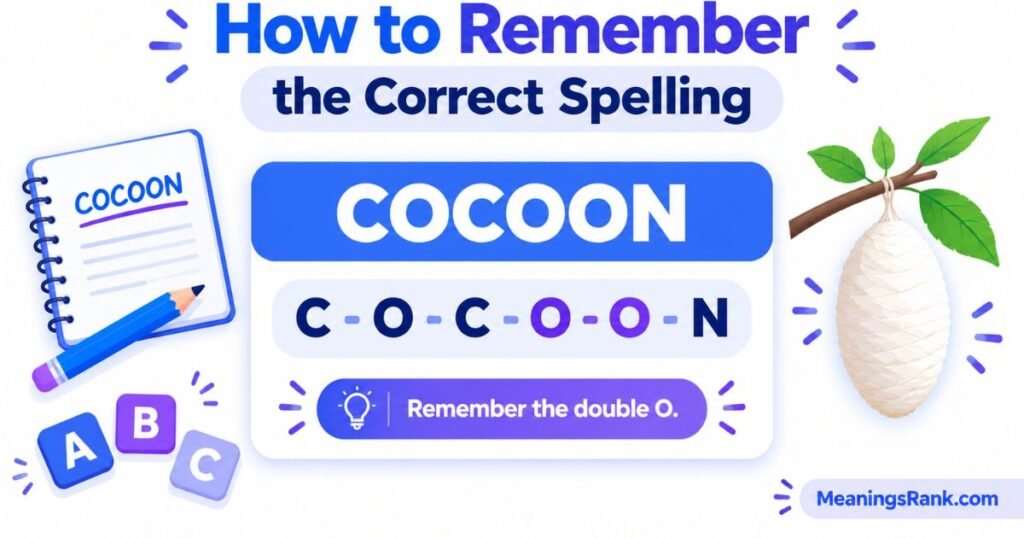
A good memory trick is short, visual, and easy to repeat. Here are several options for cocoon. Choose whichever clicks.
Trick 1: The two-eyes image. Look at the middle of the word: coon. The double O looks like a pair of eyes peeking out from a cozy blanket. Picture a small face inside a cocoon, and you will always remember the double O.
Trick 2: Count the Os. Cocoon has three Os and no A. Say it aloud: “Three Os, no A.” A quick count at the end of proofreading will catch the error.
Trick 3: Match the pairs. The word breaks into CO and COON. The pair starts with CO and ends with COON, so the C-O pattern appears twice. Writing it as “co-coon” makes the symmetry obvious.
Trick 4: The rhyme rule. Cocoon rhymes with moon, balloon, and soon. None of those contain an A, and neither does cocoon.
Trick 5: The sentence mnemonic. Our Own Odd Owl sleeps in a cocoon. This is silly, and silly is the point. The repeated O sounds anchor the vowel pattern.
Trick 6: Say it slowly. Pronounce it as “koh-KOON,” giving the first vowel a full “oh” sound. That exaggerated pronunciation reveals the hidden O.
Pick one trick, say it three times, and write the word correctly five times on paper. Physical writing strengthens recall far better than silent reading. After a day or two, the correct form will feel automatic.
Read More: Pricy vs Pricey: The Ultimate Guide to Correct Spelling and Meaning (2026)
A Simple Way to Check Your Writing
Even confident writers benefit from a quick routine. This four-step check takes less than a minute and works for any word that looks unfamiliar.
Step 1: Search the document.
Use your editor’s find function (Ctrl+F or Cmd+F) and type “cacoon.” If it appears anywhere, replace it with “cocoon.” This single search catches every instance, including forms like “cacooned” and “cacooning.”
Step 2: Run a spelling check.
Word processors and browsers underline unknown words in red. Cacoon will be flagged because it is not in standard dictionaries. Do not click “ignore” and do not add it to your personal dictionary.
Step 3: Confirm in a dictionary.
If a suggested correction looks unfamiliar, open a trusted dictionary such as Merriam-Webster or Oxford. Type the word and compare the spelling letter by letter.
Step 4: Read the sentence aloud.
Hearing your own writing often exposes problems that your eyes skip. When you reach the word, say “koh-KOON” and picture the three Os.
For teachers, editors, and website managers, add a final step: update your style sheet or proofreading checklist so the word is on the watch list. A shared checklist prevents the same error from returning in future drafts.
Good proofreading also pays attention to the surrounding syntax. Check that your subject and verb agree, that your punctuation is clean, and that your clause structure supports the metaphor. A correctly spelled word in a broken sentence still weakens the whole paragraph.
Cocoon Spelling and Meaning at a Glance
Use this summary table as a quick reference, a classroom handout, or a bookmark for future checks.
| Item | Details |
| Correct spelling | Cocoon |
| Incorrect spelling | Cacoon |
| Syllables | Two (co-coon) |
| Pronunciation | kuh-KOON (/kəˈkuːn/) |
| Parts of speech | Noun and verb |
| Plural | Cocoons |
| Past tense | Cocooned |
| Present participle | Cocooning |
| Core meaning | A protective covering or sheltered state |
| Literal use | Silk casing spun by a moth caterpillar or silkworm |
| Figurative use | A cozy refuge, or an isolating barrier |
| Often confused with | Chrysalis (butterfly pupa shell) |
| Origin | French cocon, from Provençal |
| Regional variants | None; identical in American and British English |
| Memory trick | Three Os, no A |
If you want a one-line version, here it is: cocoon has three Os, two syllables, and one correct spelling.
Practice Exercise: Cocoon vs Cacoon
Time to test what you have learned. Fill in each blank with the correct word or form. Choose from cocoon, cocooned, cocooning, or chrysalis. Write your answers before you check the key.
1. The silkworm spun a soft white ________ around its body.
2. After a stressful week, she spent the weekend ________ at home with tea and a book.
3. The monarch butterfly hung quietly inside its green ________ on the milkweed stem.
4. The fragile sculpture was ________ in thick layers of foam before shipping.
5. Which spelling is correct: cacoon or ________?
6. True or false: The word cacoon appears in major English dictionaries. ________
7. Correct the error in this sentence: The caterpillar built a cacoon on the branch. ________
8. Name the two syllables of the word, separated by a hyphen. ________
Answer Key
- cocoon
- cocooning (the present participle after “spent the weekend”)
- chrysalis (a monarch is a butterfly, so the precise word is chrysalis)
- cocooned (past participle in a passive construction)
- cocoon
- False
- The caterpillar built a cocoon on the branch.
- co-coon
Scoring: 8 correct, you are a spelling expert. 6 to 7 correct, you have a strong grasp and just need a little review. 5 or fewer, reread the memory tricks and try the quiz again tomorrow.
FAQs
Is it cocoon or cacoon?
The correct spelling is cocoon. The form “cacoon” is a common misspelling and does not appear in any standard English dictionary. The word is spelled C-O-C-O-O-N, with three Os and no A.
What is the difference between a cocoon and a chrysalis?
A cocoon is a silk casing spun by a caterpillar, most often a moth caterpillar or silkworm. A chrysalis is the hardened outer shell of a butterfly pupa, formed from the insect’s own skin. In short, moths make cocoons and butterflies make chrysalises.
How do you pronounce cocoon?
Cocoon is pronounced kuh-KOON, with the stress on the second syllable. The first syllable is short and soft, while the second has a long “oo” sound that rhymes with “moon.” Saying it slowly as “koh-KOON” can help you remember that the first vowel is an O.
Can cocoon be used as a verb?
Yes. As a verb, cocoon means to wrap, enclose, or protect something in a sheltering layer. The forms are cocoon, cocoons, cocooned, and cocooning. For example: She cocooned herself in a warm blanket.
What does cocoon mean figuratively?
Figuratively, a cocoon is a safe, enclosed space or state. It can be positive, as in a cocoon of warmth and comfort, or negative, as in a cocoon of denial or privilege that shields someone from reality. It is also a popular metaphor for a period of quiet personal growth before a major change.
Conclusion
The question is settled: cocoon is the only correct spelling, and cacoon is an error. Remember the three Os, say the word slowly as “koh-KOON,” and use the simple search-and-replace check before you publish or submit your writing. With those habits in place, you can use cocoon with confidence as a noun, a verb, and a metaphor for comfort and growth.