
Ever read a text, tweet, or group chat message and stumbled on the word “hubris” without knowing exactly what it meant? You’re not alone. The hubris meaning trips up a lot of people because it feels like a fancy synonym for arrogance, but it actually carries a sharper, more specific edge.
This guide breaks down what hubris really means, where it comes from, and how people use it today across texting, social media, gaming chats, and everyday conversation. By the end, you’ll know exactly how to spot hubris, use it correctly, and avoid the common mix-ups people make with this word.
What Does Hubris Mean?
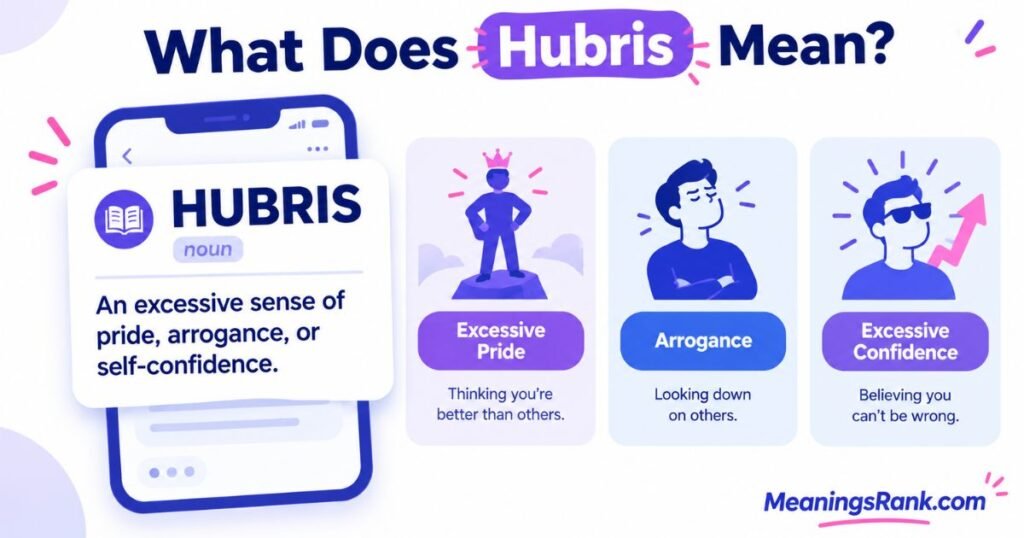
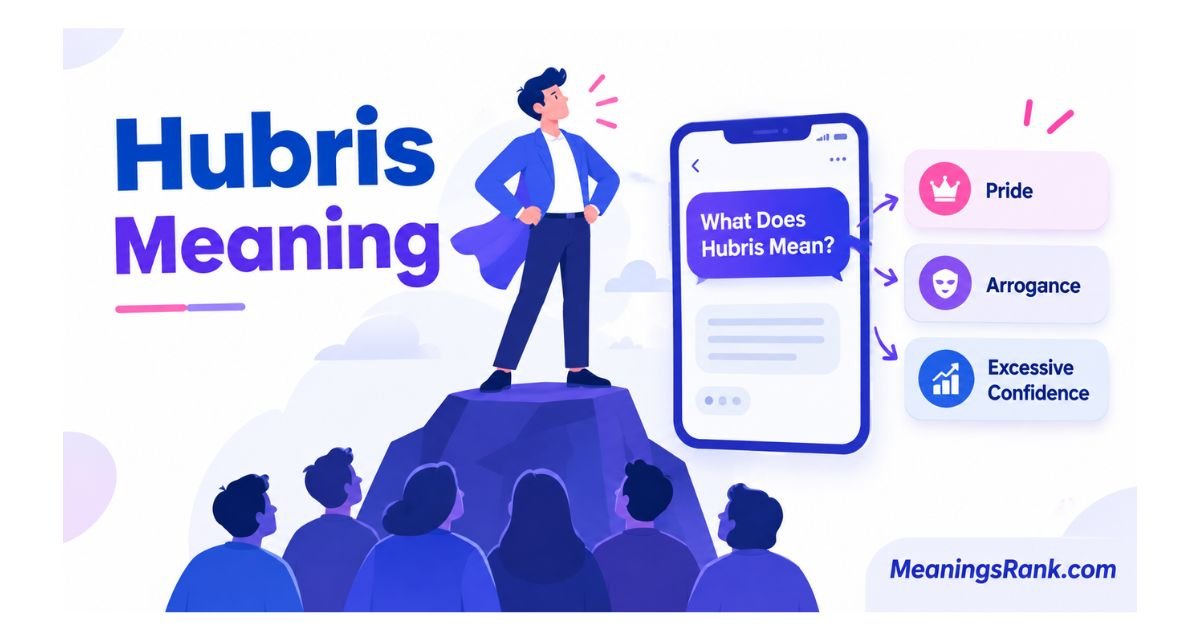
At its core, hubris means excessive pride or overconfidence, usually the kind that blinds a person to their own limits. It’s not just feeling good about yourself. Hubris is when confidence grows so big that it turns into a flaw, often leading someone to ignore warnings, disrespect others, or make a mistake they could have easily avoided.
Dictionaries define hubris as extreme pride or self-confidence, often paired with a sense of being untouchable. Think of it as pride that has gone too far and stopped being healthy.
Simple Definition of Hubris
- Hubris (noun): Dangerous overconfidence or excessive pride that leads to poor decisions or a downfall.
- Pronunciation: HYOO-bris
- Word type: Noun (no verb or adjective form in common use)
Why People Search for This Word
Most people look up hubris meaning after seeing it in a news article, book, movie review, or a message from someone trying to sound clever. It’s a word that shows up more in writing than in casual speech, which is part of why it feels unfamiliar.
The Main Hubris Meaning Explained
The clearest way to understand hubris is this: it’s pride with consequences. A person with hubris doesn’t just think highly of themselves. They believe they’re above the rules, above advice, or above failure altogether.
This is different from simply being confident. Confidence says, “I can do this.” Hubris says, “I can do this, and nothing can stop me, and anyone who disagrees is wrong.” That extra layer of dismissiveness and overreach is what makes hubris stand out.
Key Elements That Define Hubris
- Overconfidence that ignores real risks
- Disrespect toward advice, rules, or other people’s opinions
- A downfall or failure that often follows, especially in stories and history
- Blindness to one’s own weaknesses or mistakes
A Simple Way to Remember It
Picture someone so sure of themselves that they stop listening to anyone else. That’s hubris. It’s confidence that has curdled into a flaw.
How Context Changes the Meaning of Hubris
Like a lot of words, hubris shifts slightly depending on where and how it’s used. The core meaning stays the same, but the tone and weight can change.
In Casual Conversation
When friends use “hubris” in a text or chat, it’s often a lighter jab. Someone bragging about winning a game before it’s even finished might get called out with, “That’s some serious hubris.”
Also Read: BTA Meaning Slang: The Complete Guide to What BTA Means in Text & Chat
In News and Politics
Here, hubris usually points to leaders or public figures who ignore warnings or advice because they believe they’re always right. It’s a common word in political commentary and opinion pieces.
In Literature and Storytelling
This is where hubris carries the most weight. In classic stories, hubris is often the exact reason a hero falls. Their pride blinds them, and that blindness leads to their downfall.
In Business and Workplace Talk
In office settings, hubris might describe a manager who refuses to listen to their team, or a company that ignores market warnings because it assumes it can’t fail.
Is Hubris the Same as Arrogance?
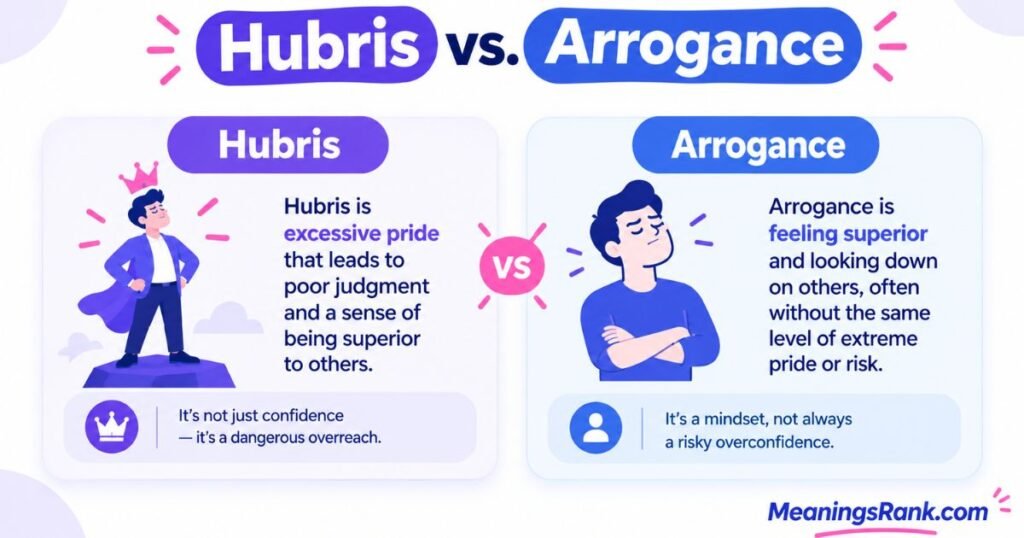
Not exactly, though they’re close cousins. Arrogance is about how someone acts, usually looking down on others or acting superior. Hubris is deeper. It’s not just an attitude, it’s a mindset that often leads to real consequences, like failure, embarrassment, or downfall.
Quick Comparison
| Term | Meaning | Key Difference |
| Hubris | Excessive pride that leads to poor judgment or downfall | Focuses on consequences, not just attitude |
| Arrogance | Acting superior or dismissive toward others | Focuses on behavior and tone |
| Confidence | Healthy belief in one’s own abilities | Positive and realistic |
So all hubris involves some arrogance, but not all arrogance rises to the level of hubris. Hubris usually needs that extra ingredient: real consequences or a fall from grace.
Hubris vs. Similar Terms
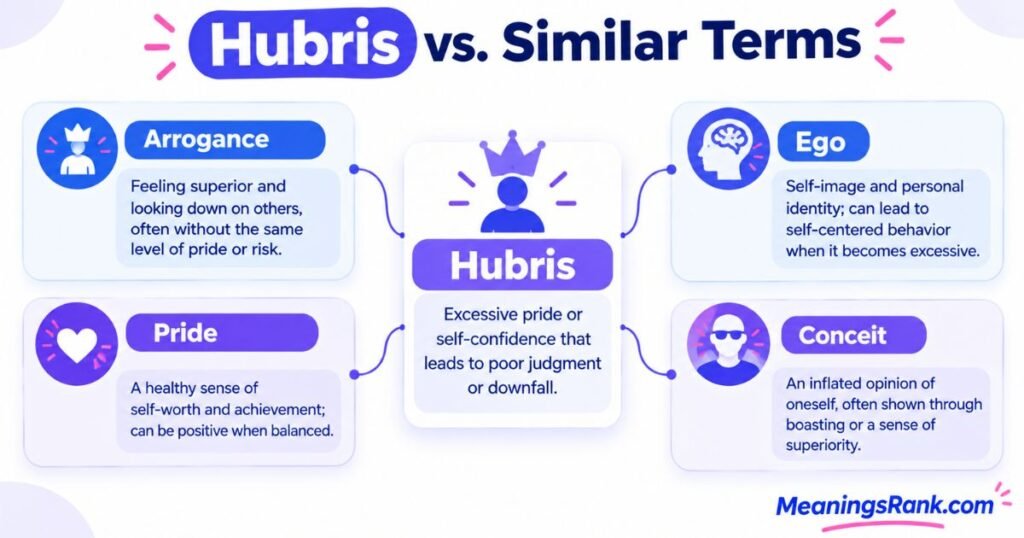
People often confuse hubris with a handful of similar-sounding or similar-meaning words. Here’s how they stack up.
Hubris vs. Ego
Ego is about self-image and identity. Hubris is about the dangerous overconfidence that grows out of an inflated ego. You can have a big ego without hubris, but hubris almost always involves an oversized ego.
Hubris vs. Vanity
Vanity is about caring too much how you look or how others see you. Hubris is about believing you’re beyond failure or criticism. Vanity is shallow; hubris is reckless.
Hubris vs. Pride
Pride can be healthy, like feeling proud of a hard day’s work. Hubris is pride taken too far, to the point where it clouds judgment.
Comparison Table
| Term | Core Focus | Positive or Negative |
| Hubris | Overconfidence leading to downfall | Negative |
| Ego | Sense of self-importance | Neutral to negative |
| Vanity | Obsession with appearance or image | Negative |
| Pride | Satisfaction in achievement | Can be positive |
Is Hubris Always Negative?
Yes, pretty much always. Unlike words like “pride” or “confidence,” hubris doesn’t really have a positive side. It’s almost exclusively used to describe a flaw, a mistake, or a character trait that leads to trouble.
That said, the intensity can vary. Sometimes hubris is used lightly and jokingly, like teasing a friend who’s overly sure about a small bet. Other times it’s used seriously, describing a major failure caused by someone’s refusal to listen to reason.
When Hubris Feels Lighter
- Joking about a friend’s overconfidence in a game
- Teasing someone who predicted an easy win that didn’t happen
When Hubris Feels Serious
- Describing a company’s collapse due to ignored warnings
- Talking about a historical figure’s downfall
- Criticizing a leader’s refusal to accept advice
Is Hubris Rude or Insulting?
Calling someone’s behavior “hubris” can feel like a strong critique, but it’s not usually considered vulgar or offensive the way slang insults are. It’s more of an intellectual or literary criticism than a casual insult.
Still, context matters. Saying “That’s hubris” about a stranger’s public mistake feels different than saying it directly to a friend’s face during an argument. In the second case, it can sting because it implies the person is blind to their own flaws.
Tips for Using It Without Sounding Harsh
- Use it about situations or ideas, not directly at a person, when you want to soften the tone
- Add humor when joking with friends, like “okay, hubris much?”
- Save the serious tone for genuine criticism, like discussing a public figure’s choices
Real-Life and Conversation Examples of Hubris
Seeing hubris in real conversations makes the meaning click faster than any dictionary definition. Here’s how it shows up across different platforms.
Text Messages
Friend 1: “I already told everyone I’m winning this weekend’s tournament.”
Friend 2: “That’s some serious hubris before we’ve even played a match.”
WhatsApp Group Chat
Group Message: “He said he didn’t need to study and still expects an A. Pure hubris.”
Instagram Comments
Comment on a post: “The confidence is giving hubris ngl 😅”
Snapchat Caption
Caption under a gym selfie: “Feeling like nothing can stop me today… let’s hope this isn’t hubris.”
TikTok Comment Section
Comment: “This is the hubris arc before the plot twist, watch.”
Discord Gaming Chat
Message: “Bro called his shot before the boss fight even started. That’s hubris and we all know it.”
Workplace Slack or Teams Chat
Message: “Ignoring the client’s feedback again feels like hubris at this point.”
How to Use Hubris Correctly in a Sentence
Using hubris the right way is easier once you see it in a few clear patterns.
Sentence Structure Tips
- Use “hubris” as a noun, never as a verb or adjective
- Pair it with words like “sheer,” “pure,” or “classic” for emphasis
- Follow it with “led to” or “resulted in” when describing consequences
Example Sentences
- “His hubris cost him the promotion he was so sure he’d get.”
- “It was pure hubris to think the plan would work without any backup.”
- “The company’s downfall is a textbook case of corporate hubris.”
- “She admitted her hubris after underestimating the competition.”
Common Sentence Templates
- “It was hubris to assume ___.”
- “___’s hubris led to ___.”
- “That’s hubris talking, not experience.”
Also Read: TBD Meaning Slang: The Complete Guide to Its Meaning, Uses & Examples
How to Describe Hubris in Different Situations
Hubris shows up in more places than just books and news headlines. Here’s how it fits into everyday scenarios.
In Sports
A player who trash-talks before a big game, only to lose badly, is a classic example of hubris in action.
In Relationships
Someone who assumes their partner will forgive anything, without ever making an effort, is showing a quieter form of hubris.
In School or Academics
A student who skips studying because they’re “just naturally smart” and then fails a big test is displaying academic hubris.
In Business
A startup founder who ignores every warning sign because they believe their idea is unstoppable often falls into classic business hubris.
In Online Debates
Someone who refuses to consider they might be wrong, even when shown clear evidence, is often accused of hubris in online arguments.
Where Does the Word Hubris Come From?
Hubris has ancient roots, tracing back to Greek mythology and literature. In Ancient Greece, hubris described extreme pride, especially pride so strong that it defied the gods themselves. It was considered one of the most dangerous human flaws because it usually invited punishment or disaster.
The Greek Origin
The word comes from the Greek “hybris,” which described actions driven by excessive pride, often involving disrespect toward gods, laws, or other people. In Greek tragedies, hubris was almost always the trigger for a hero’s downfall.
How It Entered English
Hubris moved into English through literature and philosophy, especially through translations and discussions of Greek plays and myths. Over time, it kept its core meaning: dangerous overconfidence that leads to a fall.
Why the Origin Still Matters Today
Understanding the Greek roots helps explain why hubris almost always implies consequences. It’s not just about feeling proud, it’s about pride so extreme that it practically guarantees trouble.
Hubris in Literature, Stories & Everyday Life
Hubris is one of the most common themes in storytelling because it creates such a satisfying, cautionary arc: someone rises high on pride, then falls hard because of it.
In Classic Literature
Greek tragedies are full of characters whose hubris leads directly to their destruction. This pattern became so common that hubris is now considered a classic literary theme, often discussed in schools and literature classes.
In Movies and TV Shows
Modern stories use hubris constantly. A villain who underestimates the hero because they’re “too confident to lose” is a hubris storyline. Superhero movies especially love this arc, where overconfidence becomes the character’s biggest weakness.
In Real Life
Outside of fiction, hubris shows up in real news stories all the time; think of leaders who ignore expert advice, companies that dismiss competitors, or public figures who assume they’re untouchable until they’re not.
Why This Theme Resonates
People are drawn to hubris stories because they feel like a warning. They remind us that overconfidence, left unchecked, tends to catch up with everyone eventually.
Common Mistakes About the Meaning of Hubris
Even though hubris is a well-known word, people often misuse it in small but noticeable ways.
Mistake 1: Using It as an Adjective
Incorrect: “He’s so hubris.” Correct: “He’s full of hubris.”
Mistake 2: Confusing It With Simple Confidence
Not all confidence is hubris. Confidence becomes hubris only when it ignores real risks or disrespects others.
Mistake 3: Using It for Minor Bragging
Hubris usually implies bigger stakes. Casual bragging about small things is often just confidence or cockiness, not true hubris.
Mistake 4: Thinking It Can Be Positive
Some assume hubris just means “very confident,” but it’s almost always framed as a flaw, not a strength.
Quick Fix Table
| Mistake | Why It’s Wrong | Correct Usage |
| “He’s hubris” | Hubris is a noun, not an adjective | “He’s full of hubris” |
| Using it for small brags | Hubris implies real risk or downfall | Save it for bigger overconfidence |
| Treating it as positive | Hubris is almost always negative | Use it to describe a flaw |
When Should You Avoid Using the Word Hubris?
While hubris is a useful word, it’s not always the right choice for every situation.
Avoid It When:
- You’re talking to someone who might not know the word, since it can come across as show-offy
- You’re simply describing healthy confidence, not overconfidence
- You want to keep the tone light and casual, since hubris can sound formal or literary
- You’re unsure if real consequences or a downfall are actually involved
Better Alternatives in Casual Chats
- “So sure of himself”
- “Way too confident”
- “Thinks he can’t lose”
Save “hubris” for moments when you want to sound intentional, thoughtful, or slightly dramatic.
How to Respond When Someone Mentions Hubris
If someone uses “hubris” in a conversation and you’re not totally sure what they mean, you don’t need to panic or Google it mid-chat. Here’s how to respond naturally.
If You Understand It
Simply agree or build on it: “Totally, that’s classic hubris.”
If You’re Not Sure
Ask casually: “Wait, is that a good thing or a bad thing?” Most people will happily explain, since it’s a word people enjoy using correctly.
In a Group Chat
You can use humor to keep things light: “Say less, I know exactly who you’re talking about.”
In a Serious Conversation
If someone uses hubris to criticize a real situation, like a work decision or public event, respond thoughtfully rather than jokingly, since the word often signals a serious point.
Quick Facts About Hubris
- Hubris comes from ancient Greek and originally described pride that defied the gods
- It’s almost always used in a negative way
- It’s a noun only, with no common verb or adjective form
- It’s a favorite theme in literature, movies, and storytelling
- It often implies a downfall or serious consequence, not just simple overconfidence
- It’s more common in writing than in everyday speech
Also Read: SB Meaning in Text: What It Means, How to Use It, and How to Reply (2026 Guide)
Frequently Asked Questions About Hubris
What is the simplest definition of hubris?
Hubris means excessive pride or overconfidence that often leads to failure.
Is hubris a compliment or an insult?
It’s almost always an insult, describing a dangerous personality flaw.
Can hubris ever be a good thing?
Rarely, since it usually leads to poor decisions or downfall.
Is hubris the same as being cocky?
They’re similar, but hubris usually implies bigger consequences than cockiness.
Where did the word hubris originally come from?
It comes from ancient Greek, describing pride that defied the gods.
Can you use hubris to describe yourself?
Yes, especially when admitting a mistake caused by overconfidence.
Final Thoughts
The hubris meaning boils down to one simple idea: pride that goes too far and causes real trouble. It’s more than confidence, more than arrogance, and definitely more than just bragging. Hubris is the kind of overconfidence that blinds people to warnings, disrespects good advice, and often ends in embarrassment or failure.
Whether you’re spotting it in a text message, a Discord chat, a movie plot, or a news headline, hubris always follows the same basic pattern: too much pride, not enough self-awareness, and consequences that follow close behind. Now that you know exactly what it means, where it comes from, and how to use it correctly, you’ll never second-guess this word again. Next time you see someone acting a little too sure of themselves, you’ll know exactly what to call it.