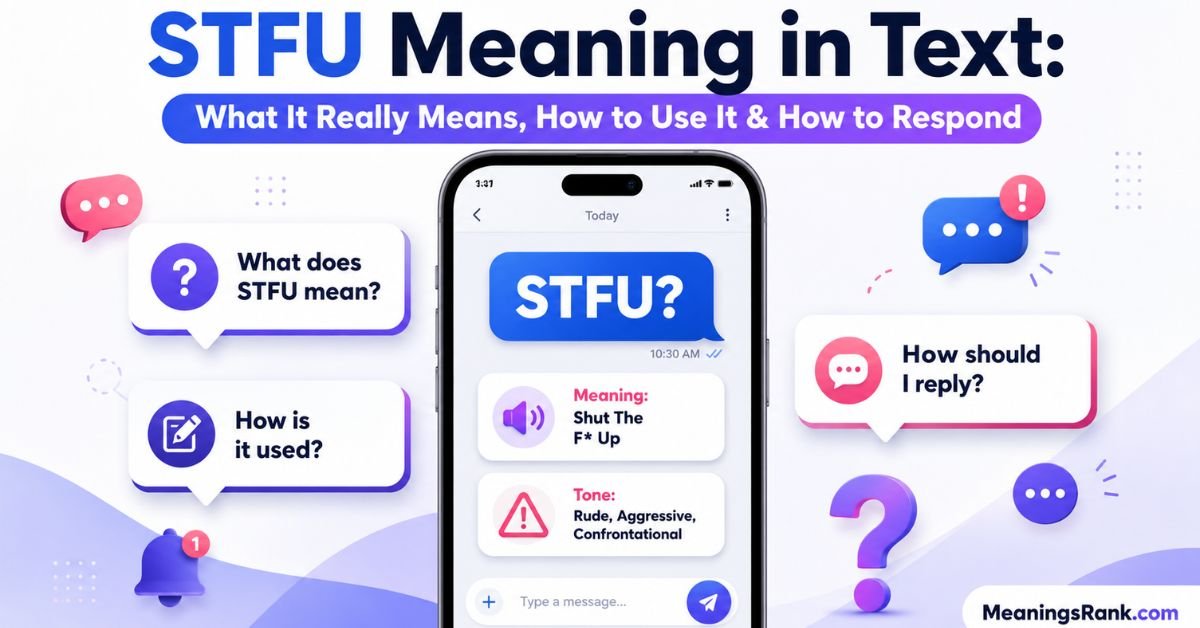

If you’ve ever gotten a text that just says “STFU,” you probably paused for a second. Was that a joke? An insult? Something worse? The STFU meaning in text depends heavily on who sent it, the tone of the conversation, and the platform you’re using. This short, sharp abbreviation has been part of internet slang for decades, and it still shows up daily on WhatsApp, Instagram, Snapchat, and group chats. It can be playful teasing between close friends or a genuine sign of anger, depending on context.
In this guide, we’ll break down what STFU really means, where it came from, how people use it across different apps, and how you should respond when it lands in your inbox.
What Does STFU Mean in Text & Chat?
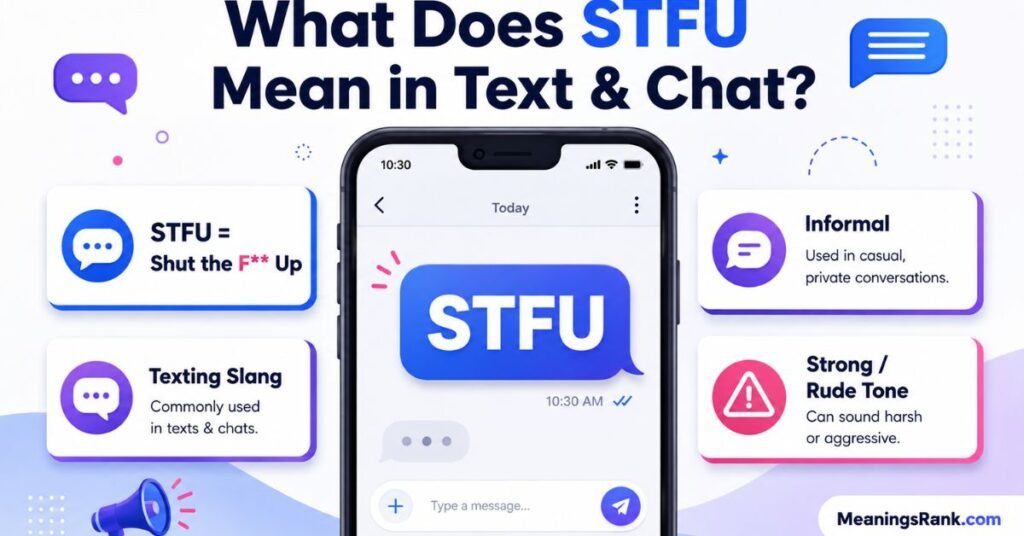
STFU is an abbreviation people use to tell someone to stop talking, often in a blunt or forceful way. In text and chat, it’s almost always informal, and the tone can swing from harsh to friendly depending on the relationship between the people texting.
Here’s the thing about STFU: it rarely means exactly what it says. Yes, it technically tells someone to be quiet, but in real conversations, it’s often used to react to shocking news, funny stories, or unbelievable gossip. Someone might text “STFU, no way that happened!” after hearing surprising information, and there’s no anger involved at all.
Context clues that help you understand the real meaning include:
- The punctuation used (STFU!! vs. stfu.)
- Whether emojis are attached (😂 vs. 😡)
- The relationship between sender and receiver
- What was said right before it
STFU Full Form, Stands For & Short Meaning
STFU stands for “Shut The F* Up.”** It’s a censored or shortened way of writing a phrase that’s considered rude or vulgar in polite conversation. Because typing out the full phrase feels aggressive, people shortened it into an acronym that softens the blow while still getting the message across.
| Term | Full Form | Tone |
| STFU | Shut The F*** Up | Strong, blunt |
| STFO | Shut The F*** Off/Out | Similar intensity |
| STFD | Shut The F*** Down | Rarely used |
Some people also use “Stop Talking, F*** you” as a joking backronym, but the standard and widely accepted full form remains “Shut The F*** Up.” It’s grouped with other blunt internet acronyms, but it carries more punch than milder options like “hush” or “quiet down.”
The Origin, History & First Known Use of STFU
STFU didn’t start on social media. It grew out of everyday spoken slang that existed long before texting became popular. The phrase “shut the [expletive] up” has roots in casual English speech going back several decades, used to emphasize frustration more strongly than a simple “shut up.”
Also Read: SNM Meaning in Text: The Ultimate Guide to What SNM Means in Chat & Social Media
Once internet forums, early chat rooms, and instant messaging apps became popular in the late 1990s and early 2000s, users began shortening long or vulgar phrases into acronyms to type faster. STFU meaning in text became one of many acronyms born from this shift, alongside terms like LOL, BRB, and OMG.
Text messaging on early mobile phones pushed this trend further. Character limits and slow typing speeds on flip phones made abbreviations practical, not just trendy. By the time smartphones and social apps like Twitter, Instagram, and Snapchat took over, STFU was already a familiar part of online vocabulary, used across gaming communities, forums, and text threads worldwide.
How People Use STFU in Daily Conversations
STFU shows up in more places than most people realize. It’s not limited to arguments or angry exchanges. Here are common everyday uses:
- Reacting to shocking news: “STFU, she actually said that to your face?”
- Playful teasing among friends: “Stfu, you did not wear that to the interview 😂”
- Genuine anger or frustration: “STFU. I’m done talking about this.”
- Gaming callouts: “stfu and focus on the objective”
- Sarcastic disbelief: “Wait, you got the job? STFU!!”
The tone almost always depends on punctuation and follow-up messages. A lowercase “stfu lol” reads very differently from an all-caps “STFU” followed by silence. People also use it as a quick reaction to memes, gossip, or unexpected plot twists in shows they’re discussing with friends.
STFU Meaning on WhatsApp, Instagram, TikTok & Snapchat
Each platform gives STFU a slightly different flavor based on how people typically communicate there.
WhatsApp:
Since WhatsApp is often used for personal and group chats with friends or family, STFU here usually leans playful, especially in reaction to funny voice notes or unbelievable updates.
Instagram:
In comments or DMs, STFU frequently pops up as a reaction to surprising posts, achievements, or reveals. “STFU that’s your natural hair?? 😍” is a common comment style.
TikTok:
On TikTok, STFU appears constantly in comment sections reacting to talent, plot twists, transformations, or unexpected reveals in videos. It’s almost always excitement-driven here.
Snapchat:
Snapchat conversations tend to be more personal and rapid-fire, so STFU can appear in both joking and serious contexts, often paired with reaction emojis or snaps showing genuine shock.
| Platform | Common Tone | Typical Trigger |
| Friendly/teasing | Funny stories, gossip | |
| Excited/shocked | Big reveals, achievements | |
| TikTok | Amazed/hyped | Talent, transformations |
| Snapchat | Mixed | Personal updates, surprises |
Does STFU Have Different Meanings in Other Fields?
STFU is almost exclusively internet and text slang, so it doesn’t carry technical meanings in fields like medicine, law, or science. However, it does show up differently in a few niche spaces:
- Gaming communities:
Used during intense moments to tell teammates to stop talking over voice chat and focus.
Also Read: SNM Meaning in Text: The Ultimate Guide to What SNM Means in Chat & Social Media
- Streaming and Discord servers:
Moderators or streamers sometimes use it jokingly with regular viewers who constantly spam chat.
- Workplace chats (informal teams):
Rarely used professionally, but close-knit teams with casual Slack culture might use it in jest during non-work banter, never in formal communication.
Outside of internet and gaming culture, STFU has no formal or technical definition, which keeps its meaning fairly consistent no matter where you see it online.
STFU From a Girl vs. From a Guy: Does It Mean Something Different?
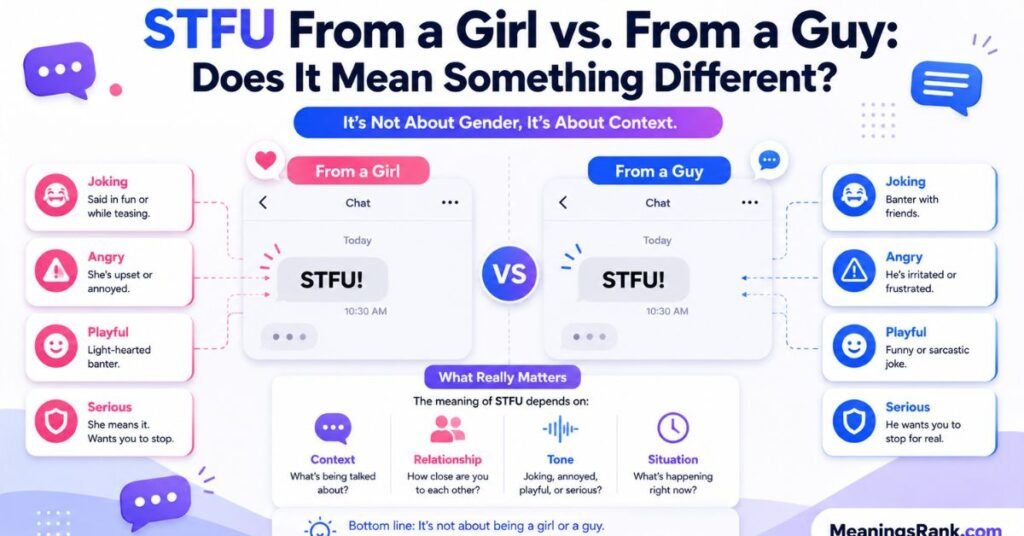
The core meaning of STFU doesn’t change based on gender, but the emotional delivery can differ depending on communication habits, relationship dynamics, and the situation itself.
From a girl:
Often used to express playful shock, disbelief, or excitement, especially with friends. It can also signal genuine irritation if paired with short, cold replies afterward.
From a guy:
Commonly used in banter with friends, gaming groups, or sports conversations. It can be lighthearted teasing or, in tenser moments, a sign of real annoyance.
The bigger factor isn’t gender, it’s the relationship and prior context. A close friend saying STFU jokingly feels completely different from a partner saying it during a heated argument. Pay attention to the conversation’s overall tone rather than assuming meaning based on who sent it.
Common Confusions, Mistakes & Wrong Interpretations of STFU
People often misread STFU because they focus only on the words and ignore the context. Common mistakes include:
- Assuming it’s always aggressive.
Many times, it’s just an exaggerated reaction to surprising news.
- Missing sarcasm.
“STFU 😂 you’re lying” is disbelief, not anger.
- Overreacting to caps lock.
Some people type in all caps out of habit, not necessarily to sound angrier.
- Ignoring the relationship history.
The same phrase means something different from a stranger versus a close friend.
- Confusing it with STFO or GTFO.
These are related but not identical in meaning or intensity.
When unsure, it’s always smart to look at the full conversation instead of reacting to a single abbreviation out of context.
Similar Terms, Alternatives & Related Slang
STFU belongs to a family of blunt internet acronyms. Here are related terms people often confuse or pair with it:
| Term | Meaning | Intensity |
| STFU | Shut The F*** Up | High |
| GTFO | Get The F*** Out | High |
| STFO | Shut The F*** Off | High |
| SMH | Shaking My Head | Low |
| IDC | I Don’t Care | Medium |
| WTF | What The F*** | High |
Milder alternatives for polite settings include “please be quiet,” “let’s pause this conversation,” or simply “shh.” These work better in professional or formal environments where STFU meaning in text would feel out of place.
STFU Examples in Real Chat Situations
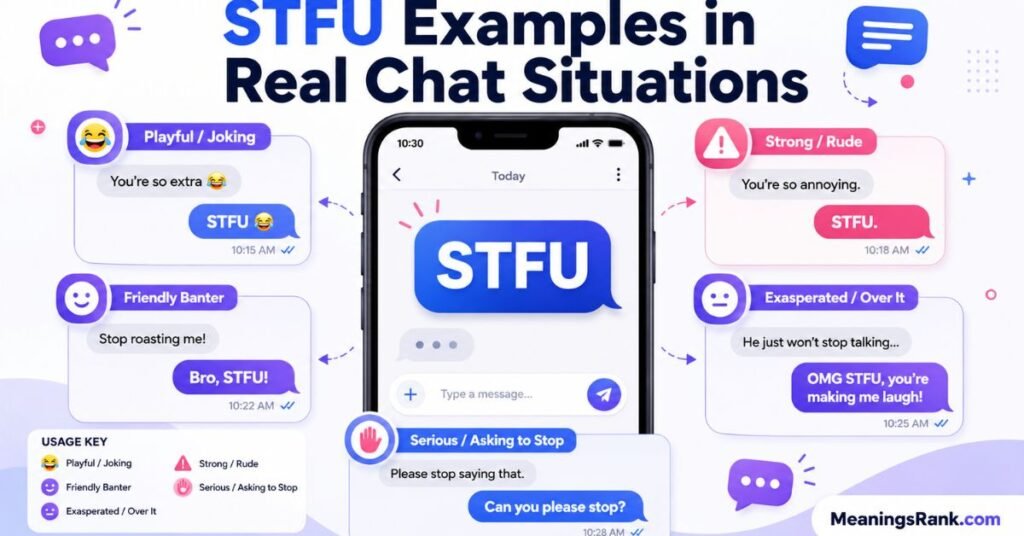
Friend group chat:
“Guess who got engaged?” “STFU, no way!! Send pics now”
Gaming voice chat:
“stfu and watch your flank, they’re pushing”
Instagram comment:
“STFU your glow up is unreal 😍🔥”
Argument text:
“I already told you my answer. STFU about it.”
Discord server:
“stfu bot, stop spamming the channel lol”
Each example shows how tone, punctuation, and setting completely change what STFU communicates, from excitement to irritation to casual joking.
How to Reply When Someone Says STFU
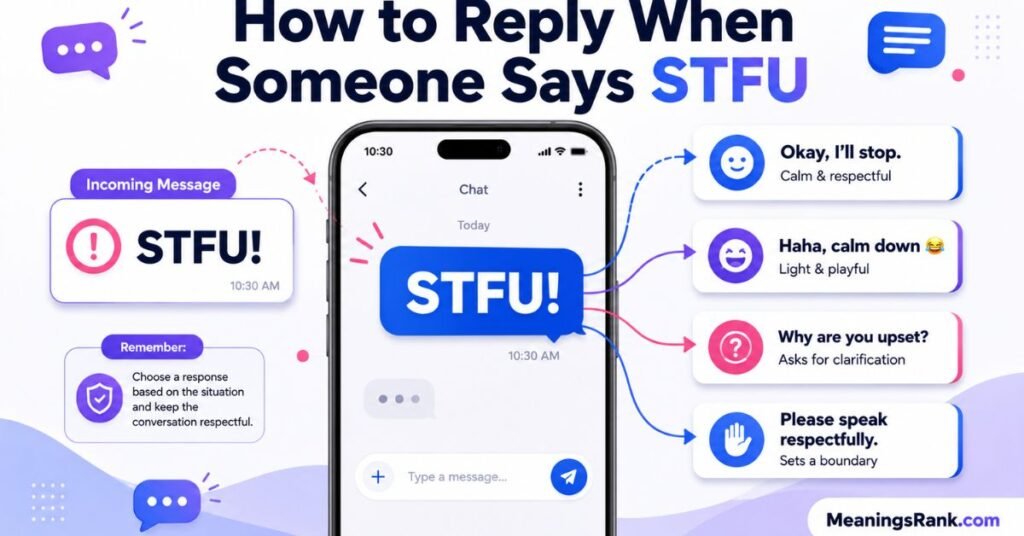
Your response should match the tone of the message, not just the words. Here’s how to handle different situations:
- If it’s playful:
Laugh it off or respond with the same energy. “lol you’re just mad it’s true” works fine.
- If it feels aggressive:
Stay calm. A simple “okay, let’s talk later” can de-escalate things.
- If it’s during an argument:
Avoid firing back with more anger. Ask directly, “Are you upset with me?” to clarify intent.
- If it’s from a stranger online:
You can ignore it, block them, or respond with humor if the context feels harmless.
- If it’s repeated and disrespectful:
It’s okay to set a boundary and say you don’t appreciate being spoken to that way.
Reading the room matters more than reacting instantly. A quick pause before replying often prevents unnecessary conflict.
Is STFU Still Popular? Trends & Online Usage
STFU remains widely used across text messages, social media comments, and gaming platforms. While newer slang terms constantly emerge, STFU has stayed relevant because it’s short, expressive, and easily understood across generations of internet users.
It’s especially common in reaction-based content, like TikTok comment sections or Instagram story replies, where quick, punchy responses dominate. Gaming culture also keeps STFU alive, since fast communication during matches favors short acronyms over full sentences. Despite changing trends in slang, STFU hasn’t faded, it’s simply adapted to fit new platforms and communication styles.
Also Read: DP Meaning: What Does DP Mean in Text, Chat & Social Media?
Quick Facts About STFU
- Full form: Shut The F*** Up
- Category: Internet and chat slang
- Common platforms: WhatsApp, Instagram, TikTok, Snapchat, Discord
- Tone range: Playful to aggressive
- First popularized: Early internet forums and chat rooms
- Related terms: GTFO, STFO, WTF
FAQs About STFU Meaning in Text
Is STFU always meant to be rude or offensive?
No, it’s often used playfully to react to shocking or funny news.
What does STFU mean from a crush or partner?
It usually signals surprise, teasing, or occasional frustration depending on context.
Can STFU be used in professional chats?
No, it’s too informal and should be avoided in workplace communication.
Is STFU the same as GTFO?
No, GTFO means “get out,” while STFU means “stop talking.”
Why do people type STFU in lowercase sometimes?
Lowercase often signals a lighter, more casual tone.
Should I be worried if someone texts me STFU?
Check the full conversation tone before assuming anger or hostility.
Conclusion
Understanding the STFU meaning in text really comes down to context. It’s a versatile piece of internet slang that can express shock, humor, irritation, or genuine anger, depending on who’s sending it and how the conversation is flowing. From WhatsApp group chats to TikTok comment sections, STFU has become a quick, expressive way for people to react without typing out long sentences. Instead of panicking the next time you see it pop up on your screen, take a second to look at the bigger picture, tone, punctuation, and prior messages all matter. Once you understand how flexible this term really is, replying becomes much easier, and you’ll never misread a simple STFU text again.