
You’re mid-conversation, and suddenly someone types “BTW” before switching topics. If you’ve ever paused to wonder what that means, you’re in good company. The BTW meaning in text is simple: it’s a quick way to bring up something extra, almost like a friendly interruption. You’ll see it everywhere texting, WhatsApp, Instagram comments, work Slack messages, even gaming chats.
It’s one of the oldest and most useful texting abbreviations still around today. Knowing how and when to use BTW helps your messages sound more natural and lets you follow conversations without missing small but important details. Let’s break it down completely.
What Does BTW Meaning in Text?
BTW is used to introduce a side comment, extra detail, or a new topic that doesn’t quite fit the main flow of conversation. It works like a gentle nudge that says, “Oh, one more thing.”
Unlike some texting slang that carries emotion or attitude, BTW is mostly functional. It helps organize a conversation by signaling a small shift.
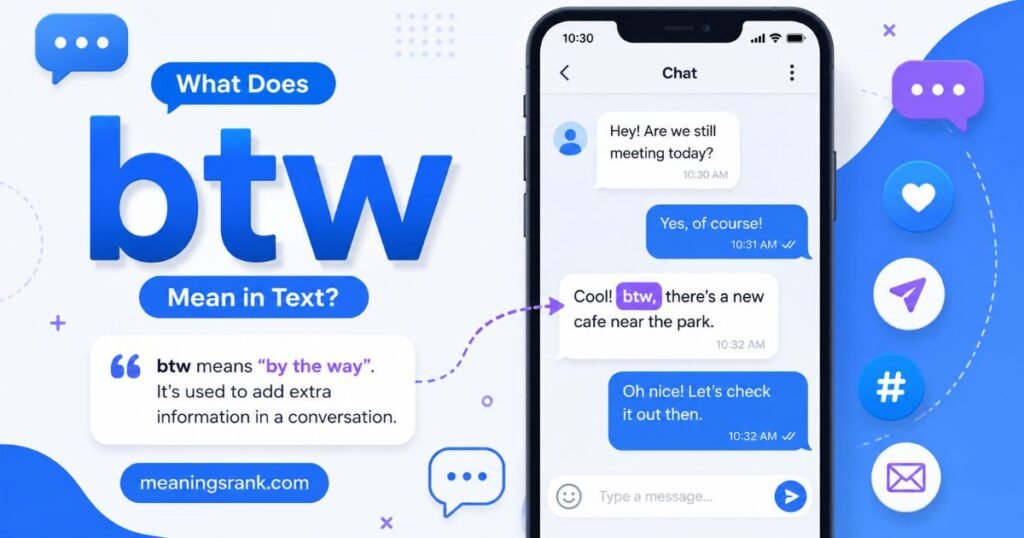
Here’s a simple example:
Person A: “I finished the report early.” Person B: “Nice! BTW, did you see the email from HR?”
In this exchange, Person B isn’t ignoring what Person A said. They’re just adding something new to the conversation, almost like a mental sticky note that popped up mid-chat.
BTW shows up constantly because conversations rarely move in a straight line. People remember things halfway through a chat, and BTW gives them an easy way to bring it up without sounding random or off-topic.
Some quick facts about how BTW functions:
- It signals a topic shift, not a disagreement or opinion
- It can introduce something important or something minor
- It works at the start of a sentence almost every time
- It rarely changes tone it stays neutral and casual
For example, “BTW, I might be late tomorrow” adds a small update, while “BTW, that email you sent had the wrong file” points out something more important. Either way, BTW keeps the shift feeling smooth instead of abrupt.
Once you recognize this pattern, spotting BTW in any conversation becomes second nature.
What Does BTW Stand For?
BTW stands for “By The Way.” It’s one of the most recognized texting abbreviations, and its meaning hasn’t changed much since it first became popular.
This phrase actually predates internet chatting. People used “by the way” in spoken conversation long before texting existed, especially to introduce side comments during a discussion.
When texting and instant messaging took off in the late 1990s and 2000s, people shortened it to BTW to save time and keystrokes. It quickly became a staple of digital conversation because it filled a real need smoothly shifting between topics.
A few interesting points about BTW’s background:
- It’s one of the few abbreviations that works the same in speech and text
- It doesn’t carry sarcasm, attitude, or hidden meaning
- It’s used across every age group, unlike some newer slang terms
- It fits naturally into both casual and semi-formal writing
You’ll usually see it written in all caps (“BTW”) or lowercase (“btw”), and both versions mean exactly the same thing. Capitalization rarely matters in casual texting.
BTW also pairs easily with other phrases for extra context, like “oh btw” or “just btw.” These small additions don’t change the core meaning they simply match the natural rhythm of how people actually talk.
Because BTW mirrors real speech patterns so closely, it feels less like slang and more like digital shorthand for something people already say out loud all the time. That’s part of why it has stayed so widely used for decades.
Read More:https://meaningsrank.com/wya-meaning-in-text/
How Is BTW Used in Real Conversations?
BTW almost always appears at the beginning of a sentence, right before the new topic or detail being introduced. This placement makes it easy to recognize instantly.
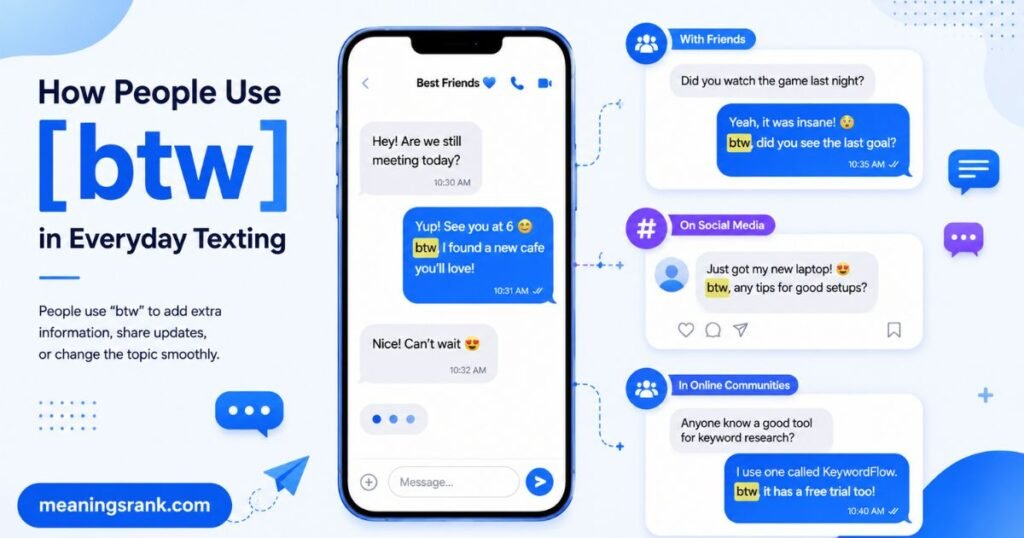
Typical Structure: “BTW, [new information or topic]”
Example: “BTW, I moved the meeting to 3 PM.”
Here’s how BTW shows up across different platforms:
Text Messages: “BTW, don’t forget your charger tomorrow.”
WhatsApp: “BTW, my number changed last week 📱”
Instagram Comments: “BTW your last post was amazing!”
Snapchat: “btw i saved that pic you sent lol”
TikTok Comments: “BTW this trend started way earlier than people think”
Gaming Chats: “BTW we should switch strategy next round.”
Discord Servers: “BTW the new update drops tomorrow.”
Workplace Chats: “BTW, I sent the updated file, check your inbox.”
Across every platform, BTW does the same job: it introduces something extra without disrupting the flow of conversation. It works especially well in workplace messaging, where people often need to add quick updates without sounding abrupt or off-topic.
In group chats, BTW is often used to bring attention to something that might otherwise get buried under multiple messages. It acts almost like a small flag, letting people know new information is coming.
Because it’s so neutral in tone, BTW rarely causes confusion. It’s one of the most predictable and easy-to-understand texting abbreviations still in daily use today.
BTW Texting Examples in Different Situations
Seeing BTW across various real-life situations makes its function even clearer. Below are realistic examples from everyday digital conversations.
Text Message: Person A: “Are we still meeting at 6?” Person B: “Yes! BTW, bring your jacket, it’s cold out.”
WhatsApp Group Chat: Person A: “What time does the movie start?” Person B: “7:30. BTW, I already bought the tickets.”
Instagram Comment: “BTW where did you get that jacket? It’s so nice.”
Snapchat Caption: “btw this is my new puppy 🐶”
TikTok Comment Section: “BTW this recipe actually works, I tried it myself.”
Gaming Voice/Text Chat: “BTW watch out, there’s an enemy camping near the bridge.”
Discord Message: “BTW the server rules got updated, check the announcements.”
Workplace Slack Message: “BTW, the client pushed the deadline to Friday.”
In each example, BTW smoothly introduces something the other person needs to know, without interrupting the main conversation. That’s really its biggest strength it adds information while keeping the chat feeling natural.
Notice how the tone barely changes between casual chats and workplace messages. BTW is flexible enough to fit almost any setting, which is part of why it has stayed so popular across so many different types of conversations.
Whether it’s small talk or an important update, BTW keeps things moving without feeling forced or awkward.
Is BTW Rude, Flirty, or Offensive?
BTW is neither rude nor offensive. It’s one of the most neutral texting abbreviations out there, mainly because it doesn’t carry emotional weight on its own.
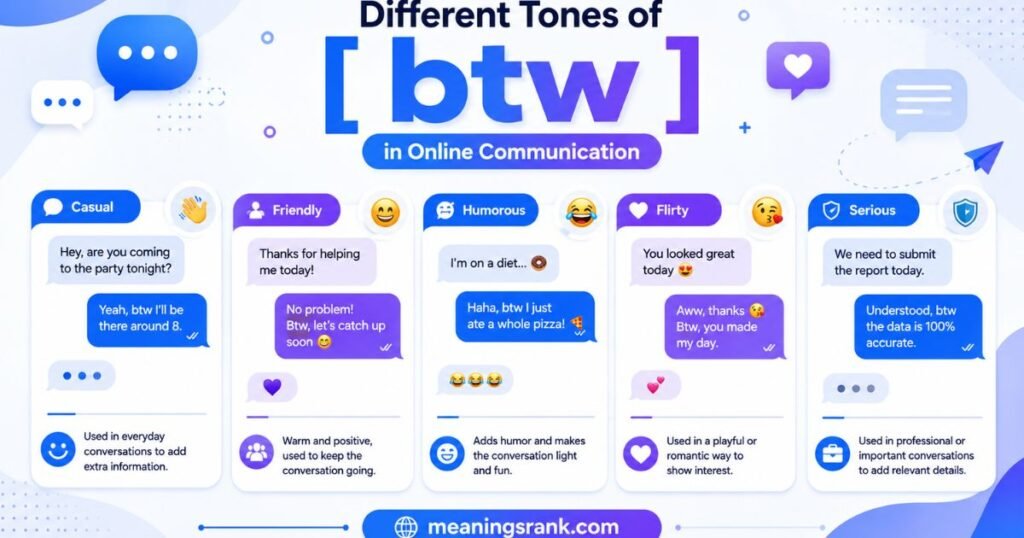
Why It’s Almost Always Polite: BTW simply introduces new information. It doesn’t judge, criticize, or push an opinion, which makes it naturally easy to use in almost any conversation.
Example: “BTW, your presentation was really well done” feels friendly and complimentary, not pushy at all.
Could BTW Ever Sound Abrupt? In rare cases, yes. If BTW introduces criticism or a correction, the tone depends heavily on the message that follows.
Example: Person A: “I finished the project.” Person B: “BTW, you forgot to attach the file.”
Here, the abruptness comes from the correction itself, not from BTW. The abbreviation is simply doing its job of introducing new information quickly.
Is BTW Ever Flirty? Not typically. BTW is functional rather than emotional, so it rarely carries romantic or flirty meaning by itself.
However, it can appear in flirty conversations without changing the tone: “BTW, I really liked talking to you today 😊”
In this case, the flirty feeling comes from the sentence itself, not from BTW. The abbreviation just introduces the compliment naturally.
Quick Summary:
- In casual chats: completely neutral and polite
- In corrections or criticism: tone depends on the message, not BTW
- In flirty texts: fine, but the romantic tone comes from surrounding words
- In professional messages: safe and commonly used
Because BTW carries so little emotional charge on its own, it’s considered one of the safest and most versatile texting abbreviations across every kind of conversation.
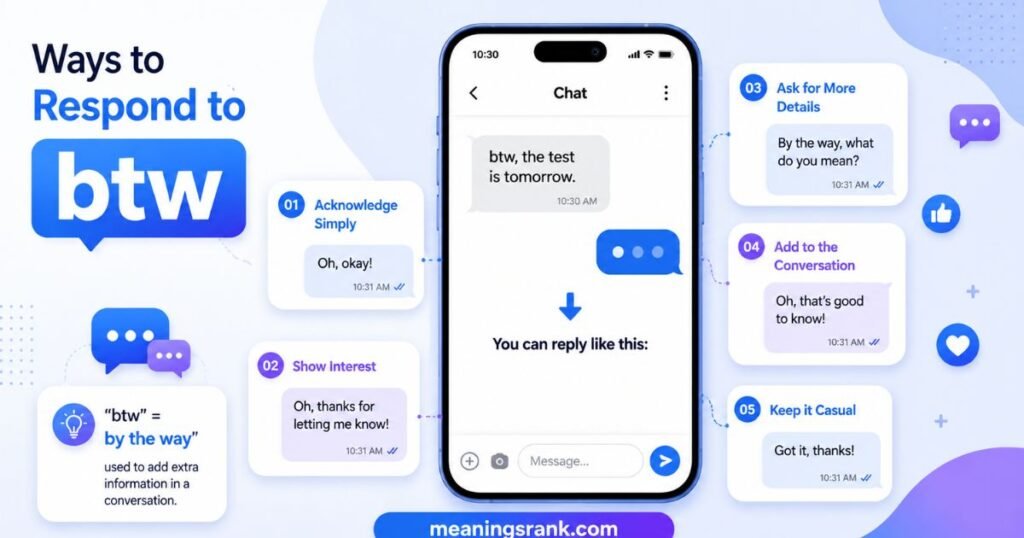
How to Reply When Someone Says “BTW”
Replying to a BTW message is usually simple since it’s introducing information rather than asking for agreement or opinion.
If It’s Useful Information: “Oh good to know, thanks!” “Got it, thanks for the heads up.”
If It Requires Action: “Okay, I’ll take care of that.” “Thanks, I’ll fix it now.”
If It’s Just a Casual Add-On: “Haha nice, thanks for sharing.” “Oh really? That’s cool.”
If You Need More Details: “Wait, can you explain more?” “What do you mean by that?”
Here’s a quick example from a workplace chat:
Person A: “BTW, the client wants the report by Friday instead of Monday.” Person B: “Got it, I’ll adjust my schedule today.”
Notice how Person B responds directly to the new information instead of ignoring it. This keeps the conversation efficient and shows the message was received clearly.
In casual chats, replies can be even shorter, especially on fast-moving platforms like Snapchat or Instagram DMs.
Example: Person A: “btw I posted a new story lol” Person B: “omg I saw, so funny 😂”
The key with BTW replies is acknowledgment. Since BTW usually introduces something new, a short response confirming you saw or understood the message keeps the conversation smooth and prevents things from getting lost in a busy chat thread.
BTW in Texting vs Formal Communication
BTW works differently depending on whether you’re texting casually or writing something more formal, like a work email or official message.
In Casual Texting: BTW fits naturally and doesn’t need any adjustment. It matches the relaxed tone of everyday conversations between friends, family, or casual acquaintances.
Example: “BTW, are we still on for lunch tomorrow?”
In Semi-Formal Messages (Slack, Teams, Workplace Chats): BTW is still acceptable, especially in company cultures that lean casual. Many workplaces use quick chat tools where BTW feels completely normal.
Example: “BTW, I updated the shared doc with the new numbers.”
In Formal Emails or Official Documents: BTW should be avoided here. Instead, use the full phrase “by the way” for a more professional tone.
Example: Instead of: “BTW, please review the attached file.” Use: “By the way, please review the attached file.”
Why This Matters: Formal writing often follows stricter tone expectations, especially in emails sent to clients, executives, or people outside your immediate team. Abbreviations like BTW can come across as too casual in these settings.
Quick comparison:
| Setting | Recommended Usage |
| Texting with friends | BTW works perfectly |
| Workplace chat apps | BTW is usually fine |
| Formal emails | Use “by the way” instead |
| Official documents | Avoid BTW entirely |
Understanding this difference helps you switch tone naturally depending on who you’re talking to, which is a skill that matters just as much online as it does in person.
BTW vs Similar Texting Abbreviations
BTW often gets grouped with other common texting abbreviations. While they may seem similar, each one serves a slightly different purpose.
| Term | Meaning | When to Use |
| BTW | By The Way | Introducing extra information or a new topic |
| FYI | For Your Information | Sharing a fact the other person should know |
| TBH | To Be Honest | Sharing a direct or honest opinion |
| IMO | In My Opinion | Sharing a personal viewpoint |
| ASAP | As Soon As Possible | Requesting urgency |
| NVM | Never Mind | Dismissing or canceling a previous statement |
BTW vs FYI: Both introduce new information, but FYI tends to sound slightly more formal and fact-based, while BTW feels more conversational.
Example: “FYI, the meeting moved to 3 PM.” (formal notice) “BTW, the meeting moved to 3 PM.” (casual heads-up)
BTW vs TBH: TBH introduces an honest or blunt opinion, while BTW introduces a new topic or detail without emotional weight.
Example: “TBH, I didn’t like the movie.” (opinion) “BTW, the movie starts at 8.” (information)
BTW vs NVM: These two are almost opposites. BTW adds something new, while NVM cancels or dismisses something already said.
Example: “BTW, I found your keys.” (adding info) “NVM, I found them myself.” (canceling the need)
Knowing these differences helps you choose the right abbreviation depending on whether you’re sharing information, an opinion, or dismissing something entirely.
Common Misunderstandings About BTW
Even though BTW is simple, a few misunderstandings pop up regularly, especially among people less familiar with texting slang.
Misunderstanding 1: BTW Always Means Something Minor Not true. BTW can introduce small talk or something genuinely important, like a deadline change or urgent update. The word itself doesn’t indicate importance.
Misunderstanding 2: BTW Is Rude When Used Before Corrections The word “BTW” isn’t rude — the correction itself creates that tone. BTW is simply a delivery method, not the source of any bluntness.
Misunderstanding 3: BTW Is Only Used by Younger People This isn’t accurate. BTW is used across all age groups, largely because it developed from a phrase already common in spoken English long before texting existed.
Misunderstanding 4: BTW Signals Sarcasm Unlike some slang terms, BTW doesn’t carry sarcastic undertones. It stays neutral no matter what follows it.
Misunderstanding 5: BTW Can’t Be Used in Professional Settings While it’s best avoided in very formal writing, BTW is completely acceptable in many workplace chat tools, especially in casual company cultures.
Misunderstanding 6: BTW Always Requires a Response Not necessarily. Sometimes BTW is just a passing comment that doesn’t need acknowledgment beyond a quick reaction or none at all.
Clearing up these small misunderstandings helps prevent awkward moments, especially in mixed-age group chats or workplace conversations where tone can sometimes get misread.
Frequently Asked Questions About BTW
1. What does BTW mean in a text message?
BTW means “By The Way.” It introduces extra information, a new topic, or a quick side comment during a conversation, without interrupting or changing the overall tone of the chat.
2. Is BTW appropriate for work emails?
It depends. BTW works fine in casual workplace chat tools like Slack or Teams, but formal emails should use the full phrase “by the way” for a more professional tone.
3. Does BTW mean someone is changing the subject completely?
Not exactly. BTW usually adds something related or relevant, even if it’s a small shift. It rarely signals a complete change of topic.
4. Can BTW be used to soften bad news?
Sometimes, yes. People use BTW to introduce updates or corrections in a casual way, though the tone still depends on the message that follows.
5. Is BTW considered old-fashioned slang?
No. BTW remains widely used across texting, social media, and workplace chats. Unlike some slang terms that fade quickly, BTW has stayed consistent for decades.
6. What’s the difference between BTW and FYI?
BTW feels more casual and conversational, while FYI sounds slightly more formal and fact-focused. Both introduce new information, but their tone differs slightly.
7. Can BTW be used to ask a question?
Yes. People often use BTW right before asking something unrelated to the main topic, like “BTW, did you finish the assignment?”
8. Is it okay to start a message with BTW?
Yes, this is actually the most common way BTW is used. Starting with BTW signals right away that new information is coming.
9. Does BTW work the same across all social media platforms?
Yes. BTW keeps the same meaning and tone whether it’s used on Instagram, TikTok, Snapchat, or in group texts. Only the surrounding context changes slightly.
10. Should I explain BTW to someone unfamiliar with texting slang?
It’s a good idea, especially with older relatives or new coworkers. Spelling out “by the way” avoids confusion and keeps communication clear.
Final Thoughts on the Meaning of BTW
At its core, the BTW meaning in text comes down to one simple idea: it’s a smooth way to add something extra to a conversation. Whether you’re texting a friend, commenting on Instagram, or updating a coworker on Slack, this small abbreviation keeps things moving naturally.
We’ve covered what BTW stands for, how it’s used across different platforms, how it compares to similar terms like FYI, TBH, and NVM, and where it fits best depending on formal or casual settings.
The next time BTW pops up in your messages, you’ll know exactly what it means and how to respond with confidence. Small abbreviations like this one make everyday digital conversations faster, but understanding them fully makes your communication even clearer.