
You are typing a message to a Spanish-speaking friend, and your fingers pause over the first word. Is it hola or ola? Both look right. Both sound identical. Yet only one of them means “hello.” The other describes something you would find at the beach.
This guide settles the question and explains why it keeps tripping people up. You will see the meaning of each word, how the silent letter h causes the confusion, where each word comes from, and how to use hola with confidence in everyday conversation. Along the way, you will find comparison tables, a memory trick, a short quiz, and answers to the questions learners ask most.
Hola vs Ola: Quick Answer and Key Differences
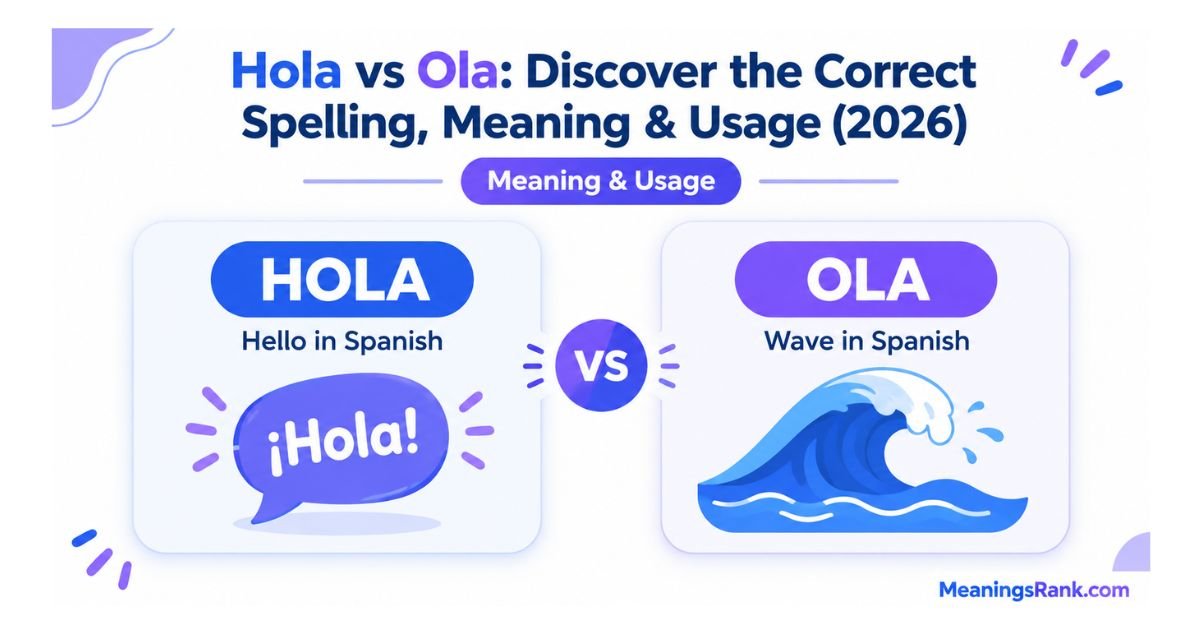
Quick Summary: Hola (with a silent h) is the Spanish greeting meaning “hello” or “hi.” Ola (no h) is a different Spanish word meaning “wave,” as in an ocean wave or a wave of heat. They sound exactly the same, but they are spelled and used differently.
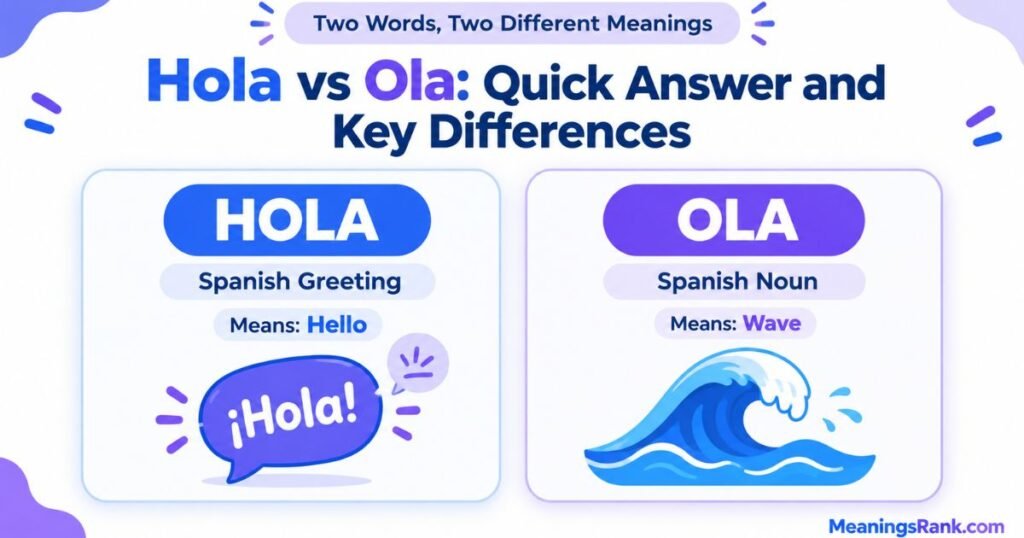
The short version fits in one table.
| Feature | Hola | Ola |
| Spelling | h-o-l-a | o-l-a |
| Part of speech | Interjection (greeting) | Feminine noun |
| Core meaning | Hello, hi, hey | Wave |
| Pronunciation | OH-lah | OH-lah |
| Example | ¡Hola, María! | Una ola enorme llegó a la playa. |
| Typical context | Greetings, chats, messages | Sea, weather, crowds, trends |
Notice the pronunciation row. Spanish pronounces the two words identically, which is the root of nearly every mix-up. Only spelling and context tell them apart.
What Does Hola Mean in Spanish?
Hola is the everyday Spanish word for “hello.” It works at breakfast, in a boardroom, on a phone call, and in a text thread. A native speaker will say it dozens of times a day without a second thought.
Core Definitions & Usage Rules
Grammatically, hola is an interjection. That means it stands alone, does not change form, and has no gender or number. You never write holas to greet two people, and you never add an article in front of it.
Here are the rules that matter most:
- Spelling always includes the h. The Spanish letter h is silent, but it stays in the written word.
- Punctuation is doubled. Spanish uses an opening exclamation mark: ¡Hola! The opening mark signals tone before the reader reaches the word.
- Capitalization follows normal sentence rules. Write Hola at the start of a sentence and hola in the middle: Le dije hola y se fue.
- A comma follows a name that comes after it. Hola, Carlos uses a comma, much like English “Hello, Carlos.”
- It is neutral in register. Hola suits friends and strangers alike. For extra formality, speakers often add a time-of-day phrase such as buenos días or buenas tardes.
Beyond greetings, hola can also express surprise or draw attention in casual speech. Someone who spots an unexpected detail might say, ¡Hola! ¿Qué es esto? That use is close to English “Well, well, what’s this?”
Read More: Ally vs Allie: Meaning, Spelling Differences & Real-Life Examples
What Does Ola Mean in Spanish?
Ola is a feminine noun that means “wave.” Its plural is olas, and it takes the article la or una: la ola, una ola, las olas.
Surfers use it. Meteorologists use it. Sports fans use it. The word covers more ground than the sea alone:
- Ocean wave: Las olas eran altas hoy. (The waves were high today.)
- Heat wave: Una ola de calor cubrió la región. (A heat wave covered the region.)
- Cold snap: Una ola de frío llegó en enero. (A cold wave arrived in January.)
- Stadium wave: Los aficionados hicieron la ola. (The fans did the wave.)
- Surge or trend: Una ola de protestas (a wave of protests) or una nueva ola de música (a new wave of music).
Because ola is a noun, it needs a sentence around it. A lone ¡Ola! does not mean “hello” in standard Spanish, and that is exactly the error you want to avoid.
One interesting wrinkle: in Galician, a language spoken in northwest Spain, ola is a legitimate greeting. Galician spelling rules differ from Spanish, so ola there means “hello.” That is a different language with its own orthography, not a Spanish variant, so the rule for Spanish stays the same.
Hola vs Ola: Meaning, Spelling & Usage Compared
Now put the two words side by side and look at how they behave in real sentences.
Real-World Examples & Transformations
| Correct | Incorrect | Why |
| ¡Hola! ¿Cómo estás? | ¡Ola! ¿Cómo estás? | A greeting needs the h. |
| La ola rompió contra las rocas. | La hola rompió contra las rocas. | A wave is ola, with no h. |
| Dije hola a mi vecina. | Dije ola a mi vecina. | “Said hello” requires hola. |
| Una ola de calor afecta la ciudad. | Una hola de calor afecta la ciudad. | A heat wave is ola de calor. |
| Hola, buenos días. | Ola, buenos días. | Spelling a greeting without h is an error in Spanish. |
And here is a quick grammar comparison:
| Grammar feature | Hola | Ola |
| Word class | Interjection | Noun |
| Gender | None | Feminine |
| Plural form | None | olas |
| Takes an article | No | Yes (la ola) |
| Works as a full sentence | Yes (¡Hola!) | No |
If you can swap the word for “hello” and the sentence still makes sense, you want hola. If you can swap it for “wave,” you want ola. That substitution test works nearly every time.
Origins of Hola and Ola: History & Linguistic Roots
The two words share a sound but not a family tree.
Hola appears in Spanish as an interjection used to call attention or greet someone. Many etymologists connect it to a similar exclamation in other Romance languages, such as French holà, which combines a call like “ho” with the adverb là (“there”). The exact path is debated, and dictionaries describe the origin cautiously. What is clear is that hola worked as an attention-getter long before it settled into the standard greeting it is today.
Ola has a more watery story. It is linked to the Latin word unda, meaning “wave,” the same root that gives English words such as “undulate” and “abundant.” Related Spanish words like onda (ripple, radio wave) show the connection. Linguists describe the shift from onda to ola as a regional development in the history of Spanish and its neighbors, and scholars still discuss the details.
Why does the h in hola exist if nobody pronounces it? Latin spelling and the habits of medieval scribes left Spanish with several silent h letters, as in hombre, hacer, and hospital. The Royal Spanish Academy (RAE) governs standard orthography and keeps the letter in place. Spelling changes slowly, and that silent letter is a fossil of the language’s history.
How Hola Is Used Around the Spanish-Speaking World
More than 500 million people speak Spanish, and hola travels with all of them. It is understood from Madrid to Mexico City, from Buenos Aires to Bogotá, and across the United States.
Regional flavor shows up in the words that surround it. In Spain, ¡Hola! ¿Qué tal? is the casual opener. In Mexico, friends say ¡Hola! ¿Qué onda? (onda is a cousin of ola). In Argentina and Uruguay, you will hear ¡Hola, che! followed by vos forms such as ¿Cómo andás? In the United States, hola appears on signs, in customer service lines, and in bilingual homes.
Across all these regions, the spelling does not change. Pronunciation shifts slightly in rhythm and intonation, but written hola remains consistent. That standard spelling is a gift for learners: one form works everywhere.
Read More: Grandad vs Granddad: Which Spelling Is Correct? (Meaning & Usage Guide)
Hola in Other Languages and Global Communication
Hola has become one of the best-known foreign greetings in the world. English speakers use it as a playful alternative to “hello,” and Spanish classes around the globe teach it on day one.
Related greetings show how Romance languages overlap:
| Language | Greeting | Note |
| Spanish | Hola | The standard form |
| Catalan | Hola | Same spelling and meaning |
| Portuguese | Olá | Accent mark, written without the h |
| Galician | Ola | Spelled without h in Galician orthography |
| French | Salut / Bonjour | Holà exists, but means “hey there” or “whoa” |
| Italian | Ciao / Salve | A different root |
Portuguese olá is a useful comparison. It drops the h and adds an accent, which reminds us that each language builds its own spelling system on top of similar sounds. If you study more than one Romance language, keep the rules separate. Writing olá in Spanish or hola in Portuguese is a classic cross-language slip.
In global communication, hola also works as a friendly signal in marketing, travel, and social media. Brands use it in headlines, and travelers use it as an icebreaker.
How to Use Hola Naturally in Everyday Conversations
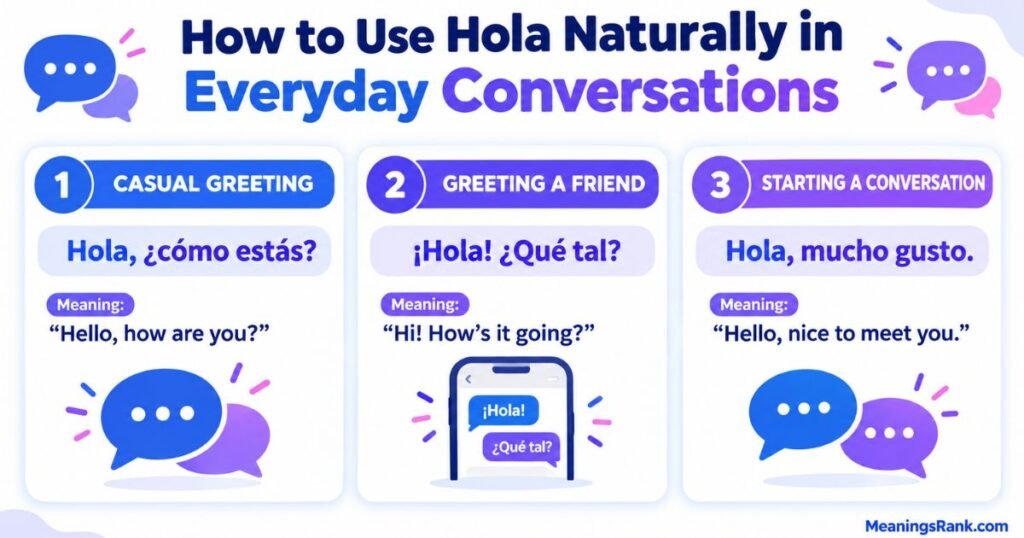
Knowing the word is one thing. Sounding natural is another. A few habits will help.
Pair it with a follow-up question:
Native speakers rarely stop at hola. They add ¿cómo estás? (how are you?) or ¿qué tal? (how’s it going?).
Match the register:
With a teacher, a client, or someone older, combine hola with buenos días and usted. With friends, keep it short: ¡Hola, amigo! In emails, Hola Ana, suits semi-formal messages, while formal letters prefer Estimada Ana: with a colon.
Pronounce it cleanly:
Say OH-lah. Skip the “h” sound completely. A breathy English h is the most common pronunciation tell for beginners.
Common Mistakes When Using Hola and Ola
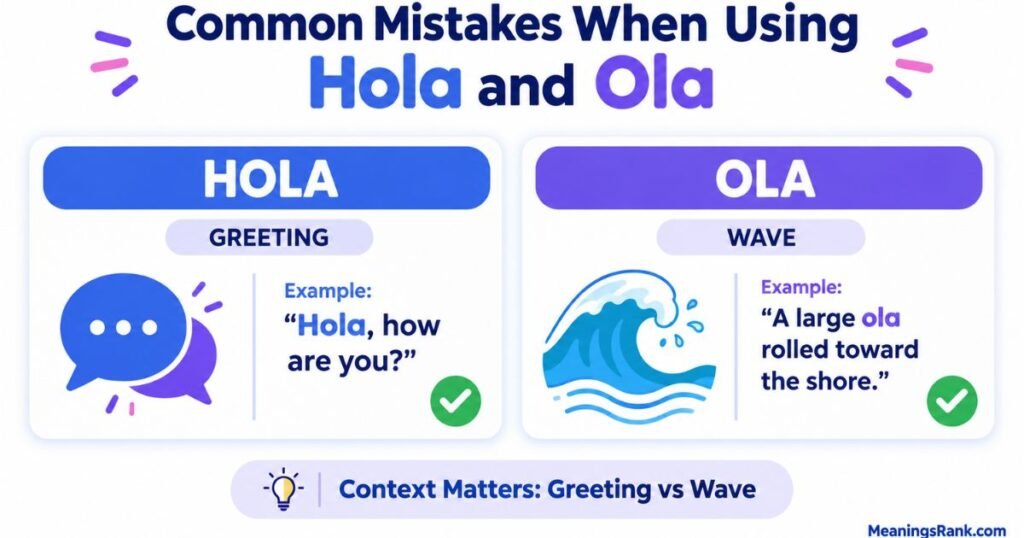
Even confident writers slip here. These errors show up most often.
- Dropping the h in a greeting. Writing Ola, ¿cómo estás? in a Spanish message is the single most common mistake. Autocorrect often fails to catch it because ola is a real word.
- Adding an h to the wave. La hola del mar looks plausible but is wrong. Waves are olas.
- Pronouncing the h. Spanish h is silent in standard speech. Pronouncing it marks you as a beginner.
- Pluralizing the greeting. There is no holas. To greet several people, say ¡Hola a todos!
- Confusing Spanish and Portuguese. Olá is Portuguese. Using it in Spanish text reads as a spelling error.
- Mixing up gender with ola. The noun is feminine: la ola, never el ola.
Key Exceptions to Keep in Mind
A few edge cases deserve attention.
- Galician writing. As noted earlier, ola is the correct greeting in Galician. If you are reading or writing Galician, the rule flips.
- Names and brands. Ola is also a given name in Scandinavian and Nigerian communities, and Ola is a well-known ride-hailing brand in India. In those contexts, Ola is correct as a proper noun. Capitalization and context make the meaning clear.
Quick Memory Trick / Mnemonic Device
Try this one: “Hola has an H for Hello.”
Both begin with the letter h in your mind, so the extra letter in hola belongs to the greeting. For the other word, picture the shape of a wave: ola is short and smooth, with no extra bump at the front, just like a wave sliding in without a head.
If you prefer a second cue, remember that ola and wave both hide an o and an a. No h in the water.
Interactive Practice Quiz
Fill in each blank with hola or ola. Write down your answers before you check the key.
- Cuando entré a la clase, dije “¡____!” a todos.
- Una ____ gigante golpeó el barco.
- Mi abuela siempre responde “____, mi cielo” cuando llamo.
- El pronóstico anuncia una ____ de calor para el fin de semana.
- En el estadio, miles de personas hicieron la ____.
Answer Key
- hola (a greeting)
- ola (an ocean wave)
- Hola (a greeting, capitalized at the start of the reply)
- ola (a heat wave)
- ola (the stadium wave)
Scoring: 5/5 means you have the rule locked in. 3 or 4 means review the substitution test (hello vs. wave). Below 3, reread the comparison tables and try again.
Understanding Spanish Homophones: Are Hola and Ola Homophones?
Yes. Hola and ola are homophones: words that sound the same but differ in spelling and meaning. Because Spanish orthography is largely phonetic, true homophones are fewer than in English, but the silent h creates a reliable cluster of them.
Other Spanish homophone pairs created by the silent h include:
| Pair | Meanings |
| ola / hola | wave / hello |
| a / ha | to (preposition) / has (auxiliary verb) |
| e / he | and (before i- sounds) / I have |
| asta / hasta | flagpole / until |
| echo / hecho | I throw / done, fact |
| onda / honda | wave, ripple / deep |
A few of these also depend on other sound patterns in Latin American Spanish, such as the merging of b and v, which produces pairs like tubo and tuvo. The takeaway is the same: context and syntax (the position of a word in the sentence) reveal which word a speaker means.
Here is the practical advice. In speech, listeners decide based on clause structure:
Dije ola sounds odd because a greeting is expected after dije. In writing, you must choose the correct spelling yourself, which is why a quick check matters. Strong punctuation habits help too: a greeting often arrives with an exclamation mark or a comma, while a noun like ola sits inside a phrase with an article or adjective.
Read More: Encorporate vs Incorporate: Correct Spelling, Meaning & Usage (2026)
Hola in Pop Culture, Media & Online Conversations
Hola turns up in more places than most learners realize.
Magazines:
The Spanish celebrity magazine ¡Hola!, founded in 1944, made the word a household brand across Spain and beyond.
Sports:
The stadium wave has a Spanish name, la ola, and many fans link it to the 1986 World Cup in Mexico, where it reached a global audience. The “Mexican wave” nickname in English reflects that story.
Social media and messaging:
On Instagram, TikTok, and WhatsApp, hola works as a quick, friendly opener. Misspellings like ola appear in casual posts, and you will spot them once you know what to look for.
Frequently Asked Questions
Is it “hola” or “ola” for hello?
It is hola. The word for “hello” in Spanish always includes the silent h. Ola means “wave.”
Why do hola and ola sound the same?
The Spanish letter h is silent in standard pronunciation. With the h removed from the sound, both words are pronounced OH-lah. The difference shows up only in writing.
Can I write “ola” as a casual version of “hola”?
Not in standard Spanish. Some people drop the h in quick texts, but it reads as a spelling error to most native speakers. The one real exception is Galician, where ola is the correct greeting.
What is the plural of “hola” and “ola”?
Hola has no plural because it is an interjection. Ola becomes olas, as in las olas del mar (the waves of the sea).
Is “hola” formal or informal?
Hola is neutral, so it fits both settings. In very formal situations, many speakers pair it with buenos días, buenas tardes, or buenas noches and use usted in the follow-up question.
Conclusion
Hola means “hello” and keeps its silent h. Ola means “wave” and drops it. They share a sound, so only spelling and context separate them.
Use the swap test (hello or wave?), lean on the mnemonic “Hola has an H for Hello,” and watch for the common slips: the missing h, the pronounced h, and the Portuguese olá. A little attention now keeps your Spanish writing clean, confident, and correct.