
You send a compliment or do someone a favor, and back comes a quick “TY.” Short, simple, and easy to miss if you’re not paying attention. The TY meaning in text comes down to one thing: it’s a fast way of saying thank you. You’ll see it in texts, WhatsApp chats, Instagram comments, gaming lobbies, and even workplace messages. It’s one of those abbreviations that barely needs explaining once you see it a few times, but it still trips up people who are new to texting slang.
Understanding TY helps you read tone correctly and reply the right way, especially in fast-moving group chats where a small “TY” can carry real gratitude. Let’s go through everything it means.
What Does TY Mean in Text & Chat?
TY is a short way of typing “thank you.” People use it whenever they want to show appreciation quickly, without typing out the full phrase.
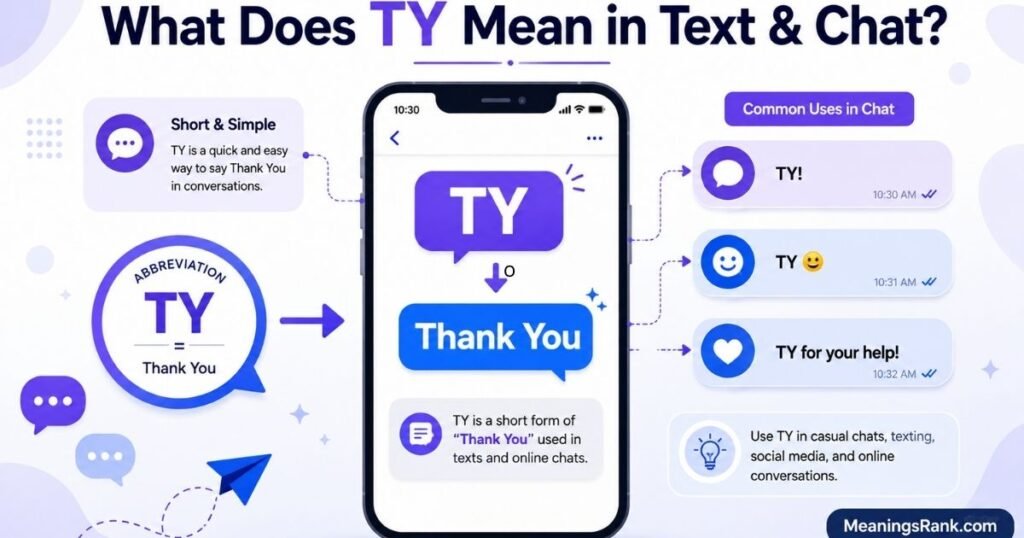
It’s casual and works in almost any situation where you’d naturally say thanks. Speed matters in texting, and TY delivers the same warmth in half the characters.
Here’s a simple example:
Person A: “I sent you the notes from class.”
Person B: “TY! I was worried I missed something important.”
In this chat, Person B isn’t just acknowledging the message. They’re genuinely grateful, and TY gets that feeling across instantly.
A few quick things worth knowing about TY:
- It’s used the same way as “thanks” or “thank you”
- It fits casual chats better than formal writing
- It can stand alone or lead into a longer sentence
- It’s often paired with emojis to add warmth
For example, “TY so much 😊” adds extra emotion, while a plain “ty” can feel more neutral or quick. Either way, the core meaning stays the same gratitude, expressed fast.
Once you spot this pattern, you’ll notice TY showing up constantly, especially in conversations where people are typing quickly on their phones and don’t want to slow down the flow of the chat.
TY Full Form, Meaning & What It Stands For
TY stands for “Thank You.” There’s no hidden twist here it’s a direct, letter-by-letter shortcut for one of the most common phrases in the English language.
Because “thank you” is used so often in daily life, shortening it made sense once texting became a normal way to communicate. Fewer keystrokes, same message.
Some quick facts about the TY full form:
- It works exactly like saying “thank you” out loud
- It doesn’t carry sarcasm on its own, unlike some slang terms
- It’s used by people of all ages, not just younger texters
- It can be typed in caps (“TY”) or lowercase (“ty”) with no change in meaning
You might also see extended versions like “tysm” (thank you so much) or “tyvm” (thank you very much). These add extra emphasis without changing what TY fundamentally means.
Because the full form is so simple, TY rarely confuses anyone once they’ve seen it used a couple of times. It’s one of the most beginner-friendly texting abbreviations out there.
Also Read: What Does TYSM Mean in Text? Meaning, Usage & Examples
Origin, History & First Known Use of TY
TY isn’t a new invention. It grew out of early internet chatrooms and instant messaging platforms back in the late 1990s and early 2000s, when typing speed mattered a lot.
Back then, dial-up internet was slow, and every extra keystroke added time. Short, functional abbreviations like TY became popular because they kept conversations moving without losing meaning.
A few historical notes worth knowing:
- TY appeared alongside other early chat abbreviations like LOL, BRB, and AFK
- It became common in platforms like AOL Instant Messenger and early forums
- Gaming communities adopted it early, especially in team-based games where quick communication mattered
- It survived the shift from chatrooms to texting to modern social media, largely unchanged
Unlike some slang terms that fade after a few years, TY has stuck around because it serves a simple, universal purpose. People will always need a fast way to say thanks, and TY fills that gap perfectly.
Its long history also explains why it feels so natural across different age groups. Older internet users grew up with it in chatrooms, while younger users picked it up through texting and social media, creating a rare abbreviation that spans generations smoothly.
How People Use TY in Daily Conversations
TY usually appears as a direct reply to something helpful, kind, or appreciated. It rarely starts a new topic instead, it responds to what just happened in the conversation.
Typical Structure:
“TY!” or “TY + [extra comment]”
Example: “TY, that really helped me out.”
Here’s how TY shows up in daily texting patterns:
- Replying to a compliment: “TY, that means a lot!”
- Responding to help: “TY for grabbing my mail.”
- Reacting to a gift or gesture: “TY so much, I love it!”
- Acknowledging information: “TY for letting me know.”
TY often shows up paired with an emoji or a follow-up sentence to add warmth, especially in personal conversations. A plain “ty” can feel a little flat in some contexts, so people naturally add extra words or emojis when the gratitude feels stronger.
Example:
Person A: “I covered your shift today.”
Person B: “TY so much, you’re a lifesaver 🙏”
In workplace or more neutral settings, TY often stays simple and short, without extra emotional add-ons.
Example:
Person A: “I updated the spreadsheet for you.”
Person B: “TY, appreciate it.”
This flexibility is exactly why TY fits so easily into almost any type of daily conversation, whether it’s emotional, casual, or strictly practical.
TY Meaning on WhatsApp, Instagram, TikTok & Snapchat
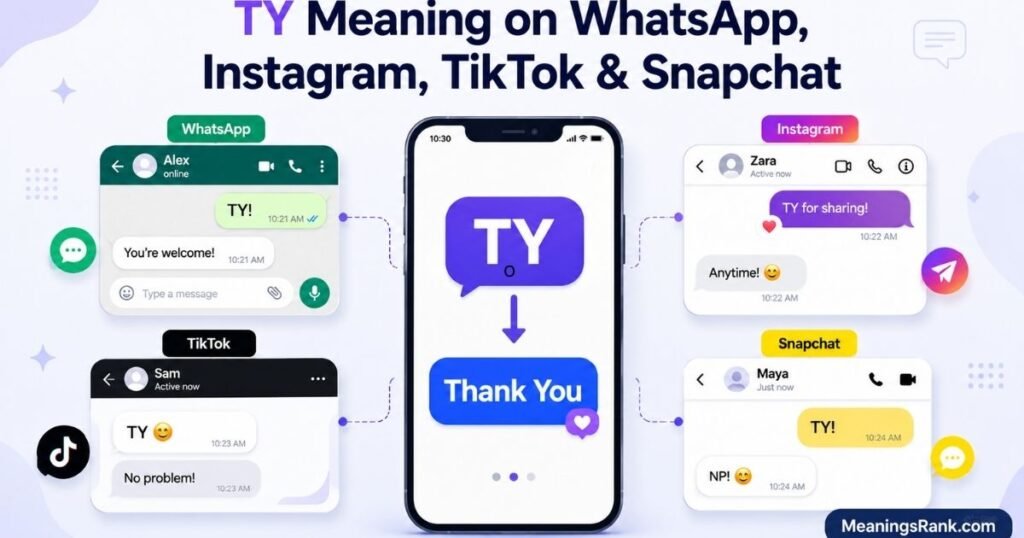
TY works the same way across every major platform, but the tone can shift slightly depending on where it’s used.
WhatsApp:
“TY for sending that address, I almost got lost 😅”
Instagram Comments:
“TY for the shoutout! Means a lot 💕”
TikTok Comments:
“TY for this recipe, I tried it and it’s so good”
Snapchat:
“ty for the snap back lol”
Gaming Chats:
“TY for the assist, that was close.”
Discord Servers:
“TY for fixing the bug so fast.”
Workplace Chats:
“TY for sending the report early, really helped my schedule.”
Across all these platforms, TY keeps its core meaning: quick, genuine thanks. The difference lies mostly in tone. On Instagram and TikTok, TY often comes with emojis or exclamation points to match the platform’s expressive style. In gaming and Discord, it tends to stay short and functional, especially during fast-paced matches where typing time is limited.
On WhatsApp, TY often appears in longer conversations, sometimes followed by more detail, since WhatsApp chats tend to feel more personal and ongoing compared to quick social media comments.
Workplace chats usually keep TY simple and professional, without heavy emoji use, matching the more neutral tone expected in work environments.
No matter the platform, TY does the same job everywhere — expressing thanks quickly, without slowing down the conversation.
Other Meanings of TY in Different Contexts
While “thank you” is by far the most common meaning, TY can occasionally stand for other things depending on context. Recognizing these differences avoids confusion.
| Context | Meaning of TY |
| Texting & Chat | Thank You |
| Gaming (rare use) | Sometimes short for “Try” in specific slang |
| Business/Finance | Occasionally used for “This Year” in reports |
| Names | Common short form of names like Tyler or Tyrone |
In everyday texting and social media, TY almost always means “thank you.” The other meanings are far less common and usually depend heavily on context clues.
For example: “TY closed with strong earnings” clearly relates to a business report, not gratitude, since the surrounding sentence signals a financial context.
Similarly, if someone texts “Tell TY I said hi,” they’re likely referring to a person’s name, not the abbreviation for thank you.
These alternate meanings are rare enough that most readers won’t run into them often, but knowing they exist helps prevent confusion if TY shows up somewhere unexpected, like a business article or a casual conversation about someone named Ty.
When in doubt, context almost always makes the intended meaning obvious within a sentence or two.
Common Confusions & Misunderstandings About TY
Even though TY is simple, a few misunderstandings pop up, especially among people less familiar with texting slang.
Misunderstanding 1: TY Always Sounds Sincere
Tone still depends on the rest of the message. “TY” alone can feel neutral, while “TY so much!! 🥹” feels far more heartfelt.
Also Read: SA Meaning in Text: The Ultimate Guide to Its Meaning, Uses & Examples
Misunderstanding 2: TY and TYSM Mean Different Things
They don’t. TYSM (thank you so much) is just a stronger version of TY, not a separate meaning.
Misunderstanding 3: TY Can Sound Sarcastic
It can, but only when the surrounding message suggests sarcasm, like “Wow, thanks for nothing… TY.” On its own, TY isn’t sarcastic.
Misunderstanding 4: TY Is Only for Casual Texting
Not true. TY appears in workplace chats and professional messaging tools too, especially in casual company cultures.
Misunderstanding 5: TY Requires a Reply
Not always. Many people send TY as a closing message that doesn’t need a response beyond maybe a quick emoji.
Misunderstanding 6: TY Is a New Slang Term
As covered earlier, TY has existed since early internet chatrooms, making it one of the older, more established abbreviations still in daily use.
Clearing up these small misunderstandings makes conversations smoother, especially in group chats where tone can sometimes get misread through text alone.
TY Examples in Real Chat Conversations
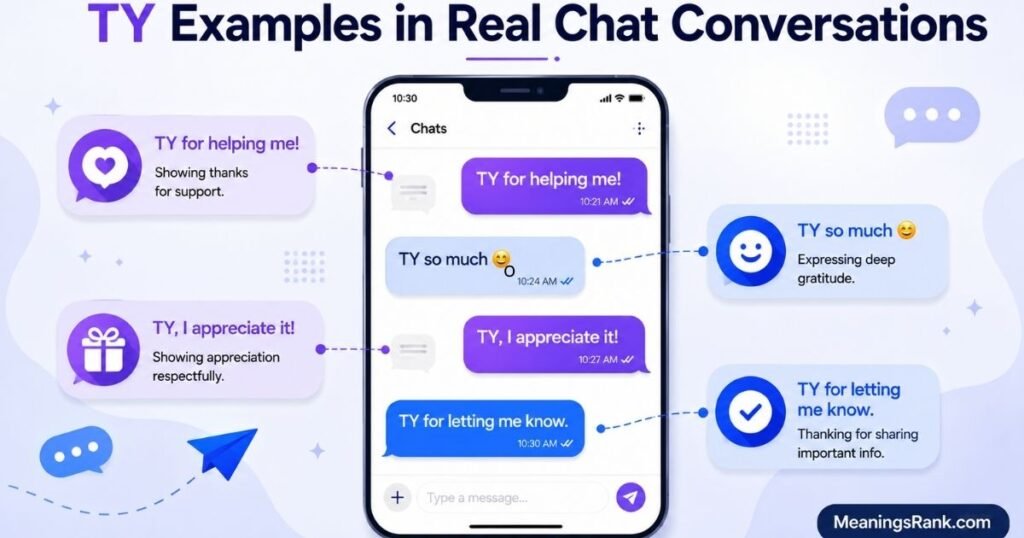
Seeing TY across different real-life situations makes its use even clearer.
Text Message:
Person A: “I picked up your prescription.”
Person B: “TY, you didn’t have to do that!”
WhatsApp Group Chat:
Person A: “I booked the table for 7.”
Person B: “TY! See everyone tonight.”
Instagram Comment:
“TY for tagging me in this, made my day 💕”
Snapchat Caption:
“ty to whoever left this on my car, made me smile”
TikTok Comment Section:
“TY for explaining this so simply, finally makes sense”
Gaming Voice/Text Chat:
“TY for the heal, that saved my life.”
Discord Message:
“TY for the quick response, issue’s fixed now.”
Workplace Slack Message:
“TY for turning that around so fast, really helped today.”
In every example, TY expresses genuine appreciation without slowing down the conversation. That’s really its biggest strength quick, clear gratitude that fits naturally into any chat.
How to Reply When Someone Says TY
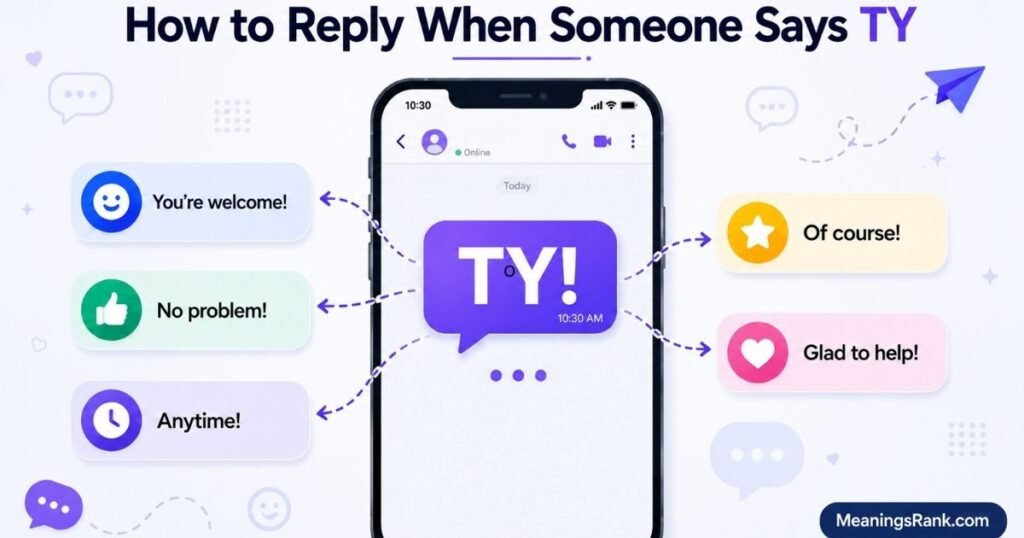
Replying to TY is usually easy since it’s a closing or appreciative message rather than a question.
If You Want to Keep It Simple:
“No problem!” “Anytime!”
If You Want to Add Warmth:
“Of course, happy to help 😊” “You’re welcome, glad it worked out!”
If It’s Casual and Quick:
“np” (no problem) “👍”
Here’s a quick example from a workplace chat:
Person A: “TY for sending that over so quickly.” Person B: “Of course, let me know if you need anything else.”
In casual chats, replies can be even shorter.
Example:
Person A: “ty for the birthday message! 🎉”
Person B: “Of course! Hope your day was great 😊”
The key with replying to TY is matching the tone. A quick “np” fits casual chats, while a slightly longer reply feels more appropriate in warmer, more personal conversations.
Is TY Still Popular in Texting?
Yes, TY remains one of the most commonly used texting abbreviations today. Unlike trendier slang that fades quickly, TY has stayed relevant because gratitude never goes out of style.
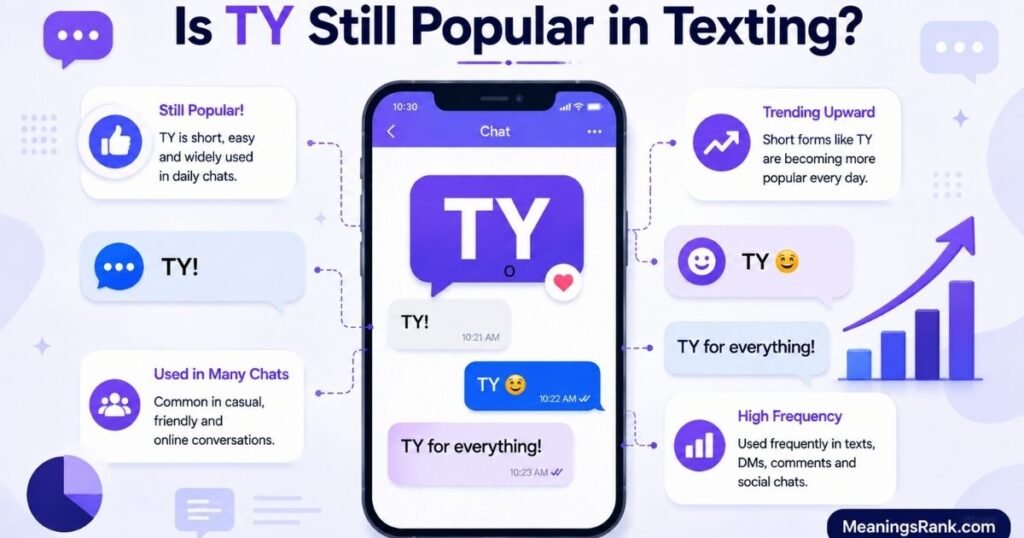
A few reasons TY continues to hold strong:
- It works across every age group and platform
- It fits both casual and semi-professional messaging
- It doesn’t require explanation, even for newer texters
- Longer versions like TYSM keep the term feeling fresh
While internet slang trends come and go, functional abbreviations tied to everyday emotions, like gratitude, tend to last much longer. TY fits into that category perfectly.
Its consistent use across texting, gaming, and social media platforms shows no signs of slowing down, especially since it solves a simple, universal need: saying thanks quickly.
Similar Terms, Alternatives & Related Slang
TY isn’t the only way to express thanks in texting. Here are a few related terms worth knowing.
| Term | Meaning | When to Use |
| TY | Thank You | Quick, casual thanks |
| TYSM | Thank You So Much | Stronger appreciation |
| TYVM | Thank You Very Much | Slightly more formal thanks |
| THX | Thanks | Casual, similar tone to TY |
| NP | No Problem | Common reply to TY |
| APPRECIATE IT | Full phrase version | Slightly warmer, more personal |
TY vs THX:
Both mean thanks, but THX feels slightly more relaxed and is often used in even faster, shorter exchanges.
TY vs TYSM:
TYSM adds intensity. It’s used when someone wants to show extra gratitude, not just acknowledge a favor.
Knowing these small differences helps you choose the right level of appreciation depending on the situation, whether it’s a quick reply or a heartfelt thank-you.
Also Read: PTSO Meaning: What Does PTSO Mean in School?
Quick Facts About TY
- TY stands for “Thank You”
- It originated in early internet chatrooms during the late 1990s
- It’s used across texting, gaming, and every major social platform
- It works in both casual and semi-professional settings
- Extended versions like TYSM add extra emphasis
- It remains one of the most widely recognized texting abbreviations today
FAQs About TY Meaning
What does TY meaning in texting slang?
TY means “thank you.” It’s a quick way to show gratitude in texts, chats, and comments without typing the full phrase.
Is TY the same as TYSM?
Not exactly. TYSM means “thank you so much,” adding stronger emphasis than the simple, neutral TY.
Can TY sound sarcastic in a message?
Yes, but only when the surrounding words suggest sarcasm. On its own, TY is genuine and neutral.
Is TY appropriate for workplace messages?
Yes, TY works fine in casual workplace chats, though formal emails should use “thank you” instead.
Where did the abbreviation TY come from?
TY started in early internet chatrooms and instant messaging platforms, becoming popular for its speed and simplicity.
Conclusion
At its core, the TY meaning in text is refreshingly simple: it’s a fast, friendly way to say thank you. Whether it shows up in a text message, an Instagram comment, or a quick reply during a gaming match, its purpose never really changes.
We’ve covered what TY stands for, where it came from, how it’s used across different platforms, and how it compares to similar terms like TYSM and THX. We’ve also looked at common mix-ups people run into and how to reply naturally when someone sends it your way.
The next time TY lands in your inbox or comment section, you’ll know exactly what it means and how to respond. Small as it is, this little abbreviation carries real appreciation, one quick message at a time.